Business cycles change quickly. In fact, they change so quickly that explanations about what is happening seldom ever keep up. Similar to fruit flies, these beliefs “live and die” (The Economist). But every once in a while, an idea with real staying power appears. A persistent concept. One of them is the idea of “disruptive innovation”.
Business cycles change quickly. In fact, they change so quickly that explanations about what is happening seldom ever keep up. Similar to fruit flies, these beliefs “live and die” (The Economist). However, every once in a while, an idea with real staying power appears. One of them is the idea of “disruptive innovation.”
Revolutions may be violent because you have to destroy something in order to build something completely new. This is not a brand-new idea in economics. The phrase “creative destruction” was first used by Austrian-born novelist Joseph Schumpeter in the 1940s, a very long time ago. He asserts that devastation might be advantageous since it aids in the advancement and reorganization of the economy.
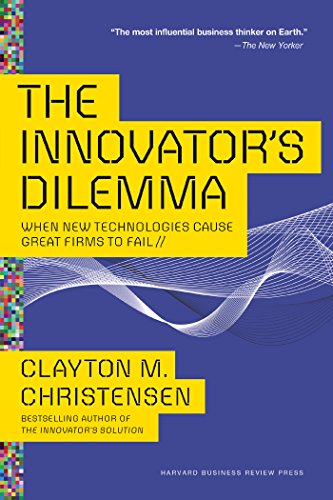
A substantial improvement to this concept was made by Clayton Christensen more than fifty years later. It’s difficult to overestimate the importance of his book “The Innovator’s Dilemma” since its release in 1997. Steve Jobs said it had a significant impact on his thinking. Michael Bloomberg sent over fifty copies to his friends. The CEO of Intel, Andy Gove, called it the most significant book of the last ten years. Within a year, more than 500,000 copies were sold.
Why did the book become so popular? It foresaw how a sizable portion of the economy will run in the new century, long before smartphones and e-commerce were widely used. Christensen was correct, too. Today, it seems evident that innovation has a destructive side: Uber destroyed the traditional taxi industry; Amazon disrupted the brick-and-mortar retail sector; and a plethora of other businesses are attempting to disrupt their own sectors.
It is the early 1950s and we are in the United States. The war has ended. People are optimistic. Economic growth is booming. Families have more money than they can spend.
That’s excellent news for a variety of businesses, including refrigerator and automobile manufacturers. Additionally, it’s wonderful for manufacturers of consumer electronics like RCA and Zenith. The vacuum tube music console, a classy veneered cabinet with an integrated radio that occupies the heart of middle-class living rooms all throughout the country, is one of their best-selling items.
These consoles are solid, well-made items. More importantly, they sound fantastic and are well crafted. They are pricey as a result of all of this, but that’s not an issue. People can afford to pay top money for what is important to them—quality—in this era of abundance. Therefore, it is what businesses prioritize. They continue to make large, pricey consoles with excellent audio by tinkering and continuously improving.
And at that point, a little Japanese company by the name of Sony steps in . It was established in 1946 with a start-up budget of around $6,000 and with fewer than twenty employees. Akio Morita, Sony’s CEO, has an idea that is about to make history.
He moves into a modest hotel in New York City and begins negotiating a license for transistor technology that is protected by a patent and is held by the American telecommunications giant AT&T. Despite receiving his license, Morita’s intention to utilize the technology to create miniature radios confounds AT&T management. They ponder why anybody would be interested in little radios. His response is vague: “Let’s see.”
In 1955, Sony released their first portable transistor radio on the market. It’s a lousy radio. The quality is significantly poorer than old vacuum tube consoles, and the static is so strong that you can scarcely hear the music. There is zero likelihood that a wealthy family that appreciates sound quality would purchase a Sony radio. But what if you haven’t got extra money? What if you are a normal American adolescent, to put it another way? Teenagers in the 1950s began purchasing a lot of Sony radios since the alternative to poor transistor radios is having no radio!
You probably have a good idea of how this narrative is going to end. Sony has a crowbar to pry open the American market thanks to their subpar radios. Additionally, transistor technology advances gradually but definitely. It will be too late for businesses like RCA and Zenith to overtake Sony by the time it is so excellent that it appeals to more wealthy market groups, such as the parents of those youngsters.
Sony targeted prosperity and managed to acquired total control over the American radio industry in this way.
Business experts came up with a clever justification for why well-known firms like RCA and Zenith eventually lose out to upstarts like Sony. It proceeds as follows.
The pace of technological development is so quick that staying stationary requires running. However, managers often overlook this reality. They neglect to make plans for the future because they are too preoccupied with what works now. That is how they are killed. Be a little complacent. Call it a lack of creativity. Call it poor leadership.
However, for Christensen, neither the Sony narrative nor any of the many other tales that fit the same pattern have that lesson as their main takeaway. He discovered that technical innovations were often created in the well-funded R&D divisions of large corporations when he studied the sectors where incumbents had been supplanted by newcomers. As we have seen, Sony, a recent newcomer into the radio industry, benefited from the advanced technology of AT&T, an established competitor. Then there is Kodak, which held the top spot in the photographic film industry for the most of the 20th century until being supplanted by digital competitors. But in the late 1970s, a Kodak engineer created the first digital camera! Numerous such instances abound.
Therefore, the true issue isn’t why huge businesses don’t innovate, but rather why they don’t make use of the game-changing technology that they often contribute to producing. Christensen’s response is that new technologies often outperform the existing ones . Sony’s portable radios have poor audio quality. The first mobile phone cameras produced subpar images. The Corona, Toyota’s debut vehicle for the American market, was no match for the cars coming off the assembly lines of GM and Ford.
Such subpar innovation, in Christensen’s opinion, is essentially disruptive. He likens it to “sustaining innovation,” which refers to ongoing experimentation that improves performance. To return to the topic of radios, businesses like RCA and Zenith continuously improved their basic offering, which became progressively better over time. Sony broke that trend. Before his transistor radios could compete with those produced by the major players in the industry, Akio Morita did not begin working in his lab. Instead, he took a chance on locating a new market that would place a premium on mobility and affordability above quality.
It also has to be a brand-new market. Customers of well-established businesses aren’t interested in innovations since they already have something that has a strong track record of success. And from the standpoint of a management, it makes perfect sense to disregard subpar new items with no market and concentrate a business’ efforts on enhancing the high-margin products that do have consumers.
But such new markets often prove to be quite lucrative. Teenagers will purchase subpar radios if they are inexpensive and portable. People utilized cell phone cameras despite the blurry photographs they produced because they were so handy. Although Toyota’s Coronas were ugly, they managed to hire workers for less money than GM or Ford vehicles. All of these items were quite helpful.
We now get at the problem raised in the book’s title. You can’t fund every fresh, ridiculous concept since that is how businesses go bankrupt. But suppose you keep going for those high margins while you wait to see whether that stupid idea turns out to be a brilliant one. The new market that suddenly becomes intriguing enough to engage has already been conquered by the time you realize it is. Even worse, the inferior goods produced by upstarts are probably going to become better to the point where your consumers find them appealing. That is also a formula for bankruptcy.
There is persistent innovation. There is also disruptive innovation.
Continuous innovation makes established items better. As an example, consider Gillette, a corporation that boldly claims on its website that it will only cease producing razors when it is unable to improve upon them. The first Gillette razors were simple kits with a two-piece safety razor and a double-edged blade coupled to a reusable handle. Contrarily, modern battery-operated razors include five friction-reducing blades, lubricating strips, and a precise sideburn trimmer.
Do the newest Gillette razors outperform the previous models? Sure. Are they likewise too complex and overengineered? Newcomer to the razor market The Dollar Shave Club agreed. The start-up reasoned that many individuals don’t want to spend a little lot on intricate razors. They seek for solutions that are easy, affordable, and reliable. Offering to bring such razors right to customers’ doors will establish a new market where convenience outweighs quality. Disruptive innovation would be that.
Unfortunately, new competitors enter high-value markets upstream of incumbents like Gillette. Companies that supply razors to homes now operate in this manner. For instance, Gillette’s former competitor, Harry’s now sells its goods both online and in department shops.
In other words, Gillette is caught in the “innovator’s dilemma,” which is a conundrum.
Being caught in the innovator’s conundrum is a terrifying situation. Exists a way out? It’s too soon to tell in the case of Gillette; we’ll have to wait to see whether its own home delivery subscription service will be sufficient to fight off rivals. However, finding a solution isn’t really the focus of Christensen’s book. The main lesson is that managers must first resist falling into the trap.
According to Paul Steinberg, Motorola Solutions’ chief technology officer, Christensen’s message is that businesses must learn to foster new ideas or die. When Steinberg first read The Innovator’s Dilemma, that message “scared the heck” out of him, he continues. It wasn’t just him. The lesson he imparted to a generation of business executives that fear is often the best indicator of success may be Christensen’s greatest legacy.