In the upcoming years, automation and AI are expected to continue reshaping the workforce, extending beyond traditional sectors like manufacturing and heavy industry. Fields such as journalism and medical science, where these technologies are still in their early stages, will undergo significant transformation. Businesses that fail to adapt to these changes may face obsolescence.
The book shares interesting stories, such as the
Introduction
In the upcoming years, automation and AI are expected to continue reshaping the workforce, extending beyond traditional sectors like manufacturing and heavy industry. Fields such as journalism and medical science, where these technologies are still in their early stages, will undergo significant transformation. Businesses that fail to adapt to these changes may face obsolescence.
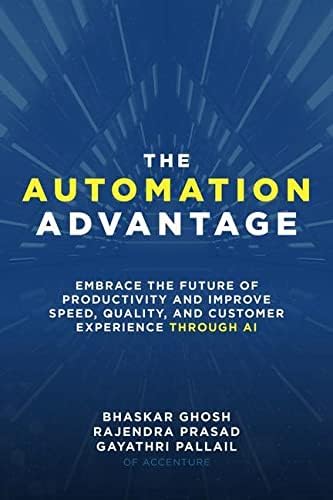
This book, “The Automation Advantage” by Bhaskar Ghosh, Gayathri Pallail and Rajendra Prasad, offers guidance and strategies to help individuals and organizations not only adapt but also thrive in the era of automation and AI. Geared toward leaders aiming to integrate these technologies into their businesses, the book emphasizes leveraging automation and AI to enhance human capabilities rather than replacing them.
Although the book caters to intermediate or advanced readers, beginners to the world of automation and AI can also benefit from its valuable insights. To provide a concise overview, we will focus on the most powerful ideas that set this book apart, including fundamental steps for automation and AI integration, creating a roadmap for automation maturity, and the importance of adopting a human-centric approach in your automation strategy.
The book shares interesting stories, such as the
Key idea 1
Let’s start by clarifying a term that will be frequently discussed in the following key ideas: Intelligent automation. When the authors refer to intelligent automation, they mean the use of machines to automate tasks such as data analysis, decision-making, and subsequent actions and learning derived from those processes. These tasks are typically performed by humans, which might raise concerns for some. However, the work of Ghosh, Pallail, & Prasad demonstrates how intelligent automation can be beneficial for teams and businesses in our ever-evolving technological landscape.
A compelling example comes from Italy’s leading newspaper, Il Secolo XIX, which, despite being innovative in the newspaper industry, faced significant challenges in the digital era. To maintain and grow their readership, the leadership realized the need to produce high-quality, cost-effective journalism. Their solution was the introduction of a virtual assistant powered by AI. This virtual assistant quickly checked articles for grammatical errors and searched the internet for relevant links, enabling journalists to reference additional sources and produce in-depth and comprehensive articles that were hard to find elsewhere.
By utilizing intelligent automation, the journalists could focus on their core tasks, while the machine handled time-consuming research and proofreading. This example illustrates how leadership can leverage automation to improve key metrics and empower employees to excel in their roles. It also emphasizes the importance of aligning business strategies with intelligent automation and integrated AI.
Now, let’s delve into the practical aspects of integrating intelligent automation with your business strategies and systems. As a leader in your organization, you need to ask yourself critical questions about the future direction of your business, the impact of industry developments, and the definition of your business value in the years to come. Answering these questions will help you devise a clear strategy that aligns all components, systems, resources, and boundaries within your organization.
It’s important to remember that while automating repetitive tasks and unlocking human potential is a worthy goal, it must also align with sound business principles. To successfully implement automation and AI integration in your organization, you need a well-thought-out strategy.
Key idea 2
What actions should be taken? Firstly, it is crucial to understand how automation will provide your organization with a competitive advantage and clearly define how it will achieve that edge. This might even involve a complete restructuring of your business model. As you embark on this journey, ask yourself whether automation and AI will be used to compete on pricing and gain market share or to out-innovate competitors and gain a long-term technological advantage.
Next, prioritize the automation projects that your business will focus on. Automation requires significant effort, so it is essential to ensure that the right projects are given priority. Evaluate multiple automation projects in development and choose the one with the strongest business case to focus on.
Moreover, effective integration of automation and AI requires close collaboration between business leaders and IT. It is essential to address customers’ pain points and tailor the technology architecture to meet their needs. Regardless of how sophisticated the tech architecture is, it must align with customer requirements.
After adopting automation, continuous improvement is vital. Avoid the mistake of thinking that automating one area is sufficient; instead, businesses should strive to continually innovate, treating each day as if it were day one of a start-up. Embracing tech innovation is crucial for remaining competitive, and the potential losses from not adopting thoroughly vetted new tech outweigh the risks of taking a calculated approach to innovation. It might be risky to fully embrace new technology immediately, but not staying current might cause your business to miss out on gaining a competitive edge.
Key idea 3
Developing an automation roadmap is crucial to clearly identify the implementation, tracking, and innovation of your integration strategy. This roadmap should be established at two levels simultaneously: one with a focus on achieving business results, and the other on enhancing automation maturity within your company. Now, let’s explore the business results roadmap. We will also cover the strategic model for successful automation maturity shortly.
The business results process is structured into three main phases. The first phase, called “Establish,” involves exploring and identifying areas with potential for automation across your business applications. In the “Scale” phase, you develop, activate, and expand your solutions, as the name suggests. Finally, in the third phase, “Operate,” you’re ready to broaden your geographic coverage to better observe the true value realization and update your intelligent automation strategies based on your learnings.
It’s important to ensure that this level of processes is interwoven with the processes focused on ensuring successful automation maturity. As we delve into this part of your strategic roadmap, keep this in mind.
Having aligned your business strategy with your automation and AI goals, the next step is integrating automation and AI into your organization. This is a methodical process that requires passing through different developmental stages.
Think of these stages like the various steps of learning to ride a bike. First, you learn to walk, then you might master a tricycle, followed by a bike with stabilizers. After going through these stages, you gain the confidence to ride a bicycle smoothly. Similarly, a business seeking automation must go through incremental progress. Starting with the foundational stages, you examine your infrastructure’s current state, identify gaps for improvement, and establish a sustainable and successful automation strategy that can adapt and grow with your business.
This approach is essential to making real advances and fully benefiting from automation’s potential.
These stages serve as the foundational elements for successful automation and AI integration.
The first stage is tools-driven, where the focus is on resolving isolated but recurring problems, mainly in implementation and areas with potential for improvement. This stage often involves fragmented and siloed automation efforts, resulting in limited overall value. Next comes the process-driven stage, during which a closer evaluation of the current automation infrastructure reveals inefficiencies in processes that fail to add value to the company’s bottom line. Identifying these inefficiencies opens up opportunities for optimization, with a keen eye on points of overlap and connection in products and services.
After the foundational and optimizing stages, your business is ready to explore robotic process automation (RPA). In this stage, repetitive tasks are automated using software programs, leading to quick wins. For example, in the customer service experience at a bank, tasks from initial queries to sophisticated responses can be handled by a chatbot. The penultimate stage is data-driven, where valuable and reliable data leads to valuable insights. This data allows you to improve predictions related to product experiences, shifting the focus from cost reduction to enhancing efficiency and agility to meet the ever-changing needs and behaviors of consumers or clients. For instance, analyzing data from various sources can provide insights into a consumer’s purchasing behavior, allowing the business to send personalized product offers.
Finally, at the top level of maturity, there’s intelligence-driven automation. In this stage, computing power is used to perform complex functions or tasks traditionally limited to humans. This includes the ability to sense and comprehend ambiguities and act upon them. For example, AI in insurance companies can detect patterns in claims management operations, flagging fraudulent claims and saving billions for the industry, impacting premiums and customers positively.
As we emphasized earlier, starting from the beginning is vital, just like learning to walk before riding a bike. To achieve the ultimate level of automation maturity and harness technological advances, all these necessary stages should be embraced. By following this guide, your organization can thrive sustainably and profitably in the future.
Key idea 4
Now, let’s delve into the practical implementation of intelligent automation in your business. First and foremost, it is essential to acknowledge that failing to adapt to technological changes could result in a business being left behind, and unfortunately, many businesses struggle to adapt. These obstacles to adaptation can be both self-imposed, such as skills deficits and resistance from leadership, or external, like outdated tech infrastructure. The solution to these challenges is to build a new system centered around automation and AI, enabling the organization to overcome these barriers and thrive in the evolving landscape.
In the information age, automation should be viewed as a means to leverage people’s talents, a key difference from the earlier waves of automation that primarily replaced labor-intensive jobs with machines. Today’s automation is about allowing machines to handle tasks they excel at, while empowering people to focus on uniquely human abilities like creativity and innovation.
As a leader, it is crucial to garner support for new technology by showcasing how it can improve employees’ job performance. When explaining the benefits of automation, avoid getting bogged down in technical jargon that may only excite software developers. Instead, emphasize practical advantages that resonate with the workforce.
An example from Shell, the fossil fuel company, illustrates this point effectively. When introducing intelligent head-mounted displays for miners, Shell’s leaders focused on the life-saving potential of the technology. Real-time assistance through the voice-controlled device could make a crucial difference in dangerous mining situations. The emphasis on practical benefits made the AI technology readily welcomed.
Another effective approach for leaders is to conduct a simple exercise involving pen and paper. Ask employees to evaluate different aspects of their jobs, using smiley, frowning, or neutral faces to depict their feelings about each aspect. Then, inquire how they would feel if the aspects of their job that elicited frowns were automated. This exercise helps employees see the positive impact automation can have on their work, transforming it from a daunting prospect to a potentially beneficial change.
Key idea 5
Integrating intelligent automation into your organization should be a comprehensive effort involving all levels of the company, from business and IT leadership to operational staff, actively contributing to the project. To guide your decision-making processes effectively, Ghosh, Pallail, and Prasad propose a model consisting of four essential S’s that lead to achieving the highest level of automation maturity: Simple, Seamless, Scaled, and Sustained.
Firstly, focus on simplicity. Conduct a thorough diagnostic check of your IT and connected business infrastructures, identifying deficits and areas for improvement. Retool your applications and architecture with the aim of simplifying functional units or modularity.
Secondly, ensure seamless integration. Your automation and AI solutions should connect harmoniously with your core systems. Additionally, foster a company culture that not only embraces these integrations but is also energized and invested in their successful implementation.
Thirdly, scalability is vital. Put your automation system and strategy into action, testing its agility, robustness, and sustainability under real-world conditions. Instead of making abrupt switches, adopt a gradual approach to integration, considering your business’s overall strategy, culture, and goals.
Talent development plays a crucial role in scaling, as all members of your organization should be prepared to be agile and adaptable as the landscape evolves.
Lastly, sustained efforts are necessary. Integrating intelligent automation is not a one-time task; it requires ongoing attention. Establish processes for keeping up with industry developments, identifying emerging possibilities, and learning from how other businesses explore these trends. Maintain a company culture that encourages everyone to share their automation challenges and solutions, promoting continuous improvement.
By following this model and incorporating the other suggestions provided, you can elevate your business’s performance and ensure that its strategic objectives are met successfully.
Key idea 6
In today’s rapidly evolving world, companies cannot afford to remain stagnant. The pace of technological advancements is so swift that those who hesitate will be left behind by their competitors. Just like traditional booksellers who were slow to embrace Amazon’s digital store or taxicab firms that ignored Uber’s success, businesses that fail to innovate will inevitably lose out. The same principle applies to automation and AI as these technologies begin to gain momentum.
Innovation requires embracing the role of a pioneer. Some companies find it challenging to take the leap into automation and AI, fearing the risks associated with adopting relatively new technology. They might wonder if it’s better to wait for things to stabilize before diving in headfirst. However, the constant rate of change can create the perception that the right time to start will never come. Unfortunately, while waiting on the sidelines, these organizations will fall further behind.
Although there may be concerns about investing in technology that might soon become obsolete, the true risk lies in missing out on the valuable learning opportunities that come with adopting automation today.
Moreover, the automation journey is continuous and never-ending. Once automation is implemented, companies must continuously improve and refine their systems to keep up with the dynamic technological landscape. Adapting and optimizing automation is essential for staying competitive and relevant in the market.
Here are the key points to remember: