We’ve all experienced it. You settle in to start working, and then you receive a text message. While responding, a news alert pops up, diverting your attention. As you begin reading it, another notification sounds: someone liked your photo from last night. Curious, you check out their profile and notice new photos. Could that be a new partner? As you’re browsing, a Slack notification rings. Suddenly, you remember—wasn’t I supposed to be working?
If you’re questioning the decline of your ability to concentrate, you’re not the only one. It appears that our collective attention spans are shrinking rapidly. Additionally, each year introduces an increasing number of distractions and interruptions.
In the upcoming key points, you will discover:
We’ve all experienced it. You settle in to start working, and then you receive a text message. While responding, a news alert pops up, diverting your attention. As you begin reading it, another notification sounds: someone liked your photo from last night. Curious, you check out their profile and notice new photos. Could that be a new partner? As you’re browsing, a Slack notification rings. Suddenly, you remember—wasn’t I supposed to be working?
If you’re questioning the decline of your ability to concentrate, you’re not the only one. It appears that our collective attention spans are shrinking rapidly. Additionally, each year introduces an increasing number of distractions and interruptions.
Unfortunately, this is not by chance. Factors ranging from Silicon Valley innovations to the layout of modern workplaces are consistently eroding our capacity for deep focus and our ability to avoid distractions.
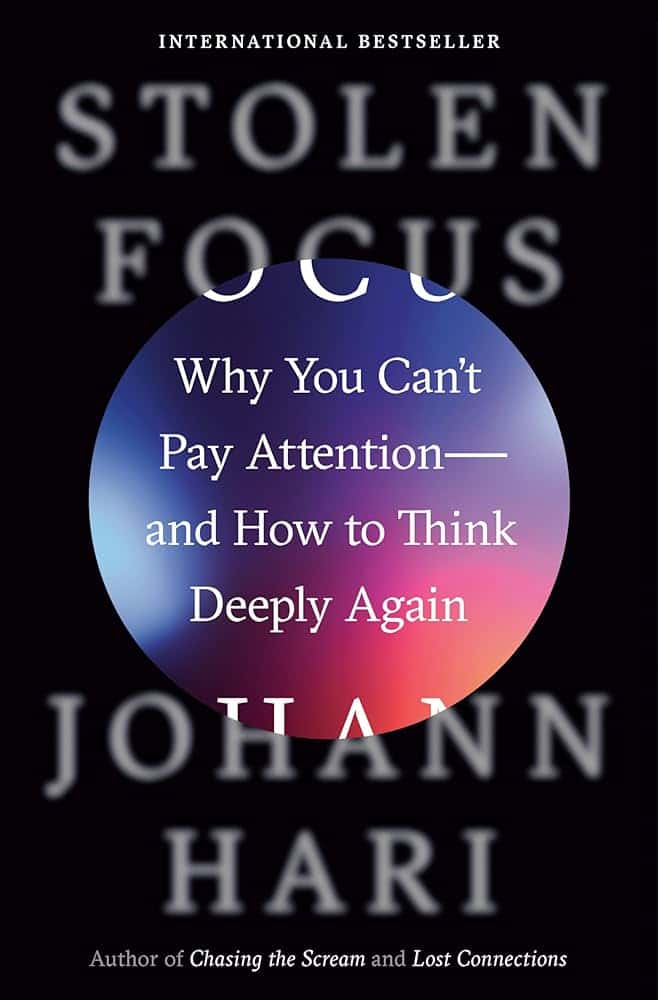
But what led us to this point? And is there a way out of this relentless cycle of dwindling attention? We’ll explore these issues in Johann Hari’s “Stolen Focus.” So, switch your devices to airplane mode, and concentrate fully on these five crucial concepts as we delve into a crisis that has become worldwide.
In the upcoming key points, you will discover:
If you’re not completely disconnected from society, you’ve likely observed how focusing has become more challenging. You’re always busy, yet accomplishing tasks is becoming increasingly difficult.
In 2016, Sune Lehmann faced similar issues. His ability to concentrate deeply was fading, and distractions affected him more than ever before. As a professor at Denmark’s Technical University, Lehmann didn’t just ignore his decreasing focus. He initiated a research project to determine if there was factual support for his concerns.
Through analyzing data from various online platforms, Lehmann and his team found a notable shift: in 2013, topics on Twitter trended for an average of 17.5 hours before public interest shifted to something new. By 2016, this duration had reduced to just 11.6 hours, marking a significant drop of almost six hours in three years. Similar trends were observed on other platforms such as Google and Reddit. Essentially, as our time spent online has increased, our attention spans have correspondingly shortened.
Is the internet solely to blame for our diminishing focus? It’s not entirely straightforward. While the digital age plays a significant part, Lehmann’s analysis of every book uploaded to Google Books from the 1880s to the present day reveals a longer historical trend. His findings show that the pace at which topics gain and lose popularity has been accelerating for decades, indicating that the roots of our dwindling attention spans predate the internet.
Lehmann’s research provides more of an indication than a complete overview. Measuring such metrics doesn’t conclusively chart the changes in our attention spans. However, if we proceed with the assumption that our ability to concentrate is deteriorating, it naturally leads us to ask: Why is this happening?
Pinpointing the exact cause is challenging, but a useful starting point is what think-tank director Robert Colvile terms “The Great Acceleration.” This concept revolves around the increasing speed at which we receive information. For instance, in the nineteenth century, it could take days for news to spread from one location to another. However, the advent of technologies such as the telegraph, radio, and television has significantly accelerated information dissemination. Additionally, the various channels through which we receive information have expanded. In 1986, the average person in the West consumed the equivalent of 40 newspapers’ worth of information daily from different sources. By 2004, this amount had increased to the equivalent of 174 newspapers. Today, it’s likely that this number has grown even more.
The internet has undoubtedly intensified this rapid pace of information flow. Nowadays, not only is information constantly accessible, but it also invades our lives through the relentless alerts and notifications from our computers and mobile phones.
Our brains are struggling to adapt to this accelerated pace. Evidence indicates they might never fully adjust. The study of our ability to concentrate is still developing, but research in speed-reading indicates there are limits to how fast we can absorb information. Neuroscientists note that the human brain’s cognitive capabilities haven’t evolved significantly in the last 40,000 years, yet the volume of information we’re exposed to has skyrocketed.
It’s hardly surprising that we often struggle to concentrate.
Facebook, Instagram, Twitter – the excessive time consumption they demand isn’t an oversight but a deliberate feature. They’re engineered to be addictive, as evidenced by Silicon Valley’s reference to their customers as “users.”
The origins of these addictive designs trace back to the Persuasive Technologies Lab at Stanford University. In the early 2000s, the lab explored if theories from prominent behavioral psychologists could be translated into computer programming to alter human behavior. As it turned out, the answer was a resounding yes.
Here’s an example. The lab studied the work of psychologist B. F. Skinner, known for his experiments with rats. He gave a rat a trivial task, like pressing a button, which naturally, the rat had no initial interest in doing. Why would it?
Thus, Skinner adjusted the task. When the rat pressed the button, it received a food pellet as a reward. Skinner discovered that rewards could motivate animals to perform tasks that they found inherently meaningless.
If the rat and button analogy seems far-fetched, consider something more familiar: the like, share, and comment buttons inspired by Skinner’s research. These features – the hearts, emojis, and retweet icons – aren’t just random elements; they’re deliberately designed to hook us into using social media more compulsively by rewarding our interactions and time spent on these platforms.
These buttons are designed to keep us engaged for extended periods, but they’re just one of several features aimed at maintaining our online presence. Another such feature is the infinite scroll. Originally, websites consisted of distinct pages; reaching the bottom of a page required a deliberate action to continue to the next. This provided a natural stopping point, prompting users to decide whether to keep browsing.
Then Aza Raskin introduced a game-changing feature: the infinite scroll. This design keeps content continuously refreshing, making it appear as though there’s an unending stream of material to consume. It’s now a common feature across almost all social media platforms. While likes and shares prompt users to extend their time online, the infinite scroll tempts them to stay online indefinitely.
Raskin has since expressed regret over creating the infinite scroll. Initially, he saw it as a sleek and effective solution, but he soon grew concerned by its impact on user behavior, including his own increased time on social media. After some calculations, Raskin estimates that the infinite scroll causes the average user to spend 50 percent more time on platforms such as Facebook and Twitter.
The business model of many online platforms is based on user engagement, which essentially measures how much time users spend interacting with their services. Tech companies value this “engagement” highly, using it as a key performance indicator, although ultimately, this translates into financial gain. The more time users spend engaged, the more opportunities there are for these companies to display ads, track user behavior, and create targeted advertising profiles. While platforms like Facebook and Instagram are free in monetary terms, the cost comes in the form of our attention, a valuable and limited resource.
In Silicon Valley, the equation is simple: time is money. They earn the money, and the time—or more precisely, your attention—is what you spend.
Digital platforms compromise our attention and use it for their financial benefit. However, these platforms also have the potential to enhance community bonds and encourage group initiatives.
To explore this potential further, consider the Complexo do Alemão favela in Rio de Janeiro, Brazil. The government adopts a military-style strategy in this densely populated, impoverished neighborhood, often deploying tanks to quell disturbances. It’s widely known that police have a shoot-to-kill policy. When children are accidentally caught in the crossfire, officers have been known to place drugs or weapons on them to justify the shootings as self-defense.
Raull Santiago, a resident of Alemão, manages the Facebook page “Coletivo Papo Reto.” This page gathers and shares videos that capture police officers shooting innocent individuals. It has mobilized residents of the favela to protest against their mistreatment and has significantly influenced public opinion in Brazil, where favelas like Alemão are frequently stigmatized.
However, conditions in Alemão have deteriorated following the election of Brazil’s far-right president, Jair Bolsonaro. Interestingly, like Coletivo Papo Reto’s influence, Bolsonaro’s success can also be linked to Facebook. His campaign flooded social media with sensationalist, fear-driven content, which played a significant role in his election. This illustrates that the same platforms that have the potential to unite us can also drive us apart.
Recently, it seems that online platforms have been more focused on creating division than fostering connections, largely due to the algorithms they use.
Recall the infinite scroll feature? The content that continuously appears on your screen isn’t shown in chronological order. Instead, it’s sorted by an algorithm designed to present material that makes us scroll more. We’re more likely to stop scrolling for content that is calm and positive. However, when we encounter content that is outrageous or controversial, it grabs our attention and keeps us engaged. This is due to a psychological effect known as negativity bias, where negative experiences have a stronger effect on us than positive ones. Consequently, it benefits social media platforms to actively provoke their users.
The algorithm itself lacks moral judgment; it merely operates according to its programming. However, those who interact with it possess emotions, beliefs, and judgments. Exposure to misinformation can make it seem more normal and even believable to some. A study conducted in 2018 looking into extreme right-wing radicals in the US discovered that many of them first became radicalized through content they encountered on YouTube.
You might avoid engaging with misinformation online, turn off your phone, or shut your laptop when online content outrages you. You may decide not to focus on provocative material. Nonetheless, this issue still impacts you.
When digital platforms favor content that is divisive and sensational, they undermine our collective ability to concentrate as a society on important issues that impact us all.
In the 1970s, researchers found a hole in the ozone layer, attributed to chemicals known as CFCs, frequently found in hairsprays. They warned that an expanding hole would lead to the loss of essential protection from the sun’s harmful rays, posing a severe threat to life on Earth. Activists rallied against CFC usage, convincing others to support their efforts. This widespread mobilization eventually pressured governments to prohibit the use of CFCs. This narrative exemplifies a triumph in environmental advocacy. However, the successful resolution might not have been achieved without directing our collective focus—initially on understanding the scientific evidence, then on embracing the perspectives of our peers, and ultimately on a concerted campaign to persuade governments to completely outlaw CFCs.
Is it possible for us to collectively concentrate on a similar issue now? The answer is already clear. Climate change presents an immediate threat to life on our planet. However, as a species, we struggle to grasp the scientific facts or even reach a consensus on whether to heed scientific advice at all.
Social media has the potential to be a beneficial tool. However, instead of leveraging this power for positive change, platforms such as Facebook focus on capturing our attention, which results in increasing division and controversy.
Facebook conducted an internal inquiry known as “Common Ground” to ascertain whether its algorithms were indeed fostering controversy and misinformation to maintain user engagement. The report unequivocally stated, “Our algorithms capitalize on the human brain’s inclination towards divisiveness.”
However, Facebook has not taken significant action in response to this troubling discovery. Similarly, we have not done much either, as we continue to be preoccupied with endless scrolling.
How many tasks are you juggling right now? Perhaps you’re simply reading this book and that’s it. If so, you’re monotasking. However, it’s more probable that you’re engaged in several activities at once: maybe you’re listening to this book while cooking, browsing the news, or talking to a roommate or partner.
It’s simple and somewhat correct to attribute our diminishing attention spans to our devices and the limitless distractions they provide online. However, that view is like a carefully edited Instagram photo: it doesn’t capture the entire story.
Consider this: there’s a basic problem with how we understand “focus.”
We exist in a fast-paced, consumer-driven society that prioritizes quick results and productivity. In this environment, we are urged to measure our attention by the immediate outcomes it produces. Our focus is seen as a tool for production, earning, and completing tasks. This perspective leads to the appeal of multitasking—why not spread our focus over multiple tasks if it means we can accomplish more at once?
As it happens, humans are quite poor at multitasking. The term “multitask” originated in the 1960s, created by computer scientists to describe computers that could handle multiple processes with their several processors. This term was never intended to describe human capabilities, since we only have one processor: our brain.
When we multitask, we’re not actually doing multiple tasks simultaneously; rather, we’re rapidly switching between them. Each switch comes with a “switch-cost” effect. When you switch tasks or get interrupted during a task, your brain needs to readjust, which lowers your mental efficiency. A study conducted by Hewlett Packard compared a group working on a task without interruption to another group that faced distractions. The study revealed that individuals in the distracted group experienced a temporary decrease of around ten IQ points while trying to complete their task.
In a workplace that praises multitasking as a hallmark of efficiency, distractions are almost promoted. Employees frequently find themselves juggling emails, engaging in several project discussions simultaneously, and managing tasks on multiple computer screens. Indeed, the typical office worker in the US dedicates about 40 percent of their time to what’s often referred to as multitasking.
Fortunately, there’s a remedy for multitasking—an approach to tasks that fosters profound concentration. Psychologist Mihaly Csikszentmihalyi described this condition as “flow,” a state of deep focus achieved when a task captivates you to the extent that you become oblivious to your environment. If you’ve ever been so engaged in an activity—be it rock-climbing, programming, painting, or working on a puzzle—that you lost track of time, you’ve experienced flow. In this state, your concentration intensifies, making you much less prone to distractions.
According to Csikszentmihalyi, the encouraging news is that anyone can achieve flow, provided certain conditions are met. Primarily, the task at hand must be inherently rewarding; flow is driven by the enjoyment of the activity itself, not the end result. Therefore, if data entry doesn’t excite you, it’s unlikely you’ll experience flow while completing spreadsheets.
Secondly, the task must be sufficiently challenging to require your complete focus but not so hard that you feel overwhelmed and consider quitting. Lastly, single-tasking is crucial. To access this deep concentration, you must dedicate all your mental resources to just one activity at a time.
High-achieving individuals such as athletes, musicians, and scientists frequently credit their success to their capacity to enter flow states. However, in a society that praises multitasking and prioritizes speed and productivity over profound concentration, it’s becoming increasingly difficult for the average person to experience flow.
In a society that glorifies multitasking, embracing alternative focus methods like flow is revolutionary. Achieving this isn’t just about slowing down or disconnecting. Simply turning on airplane mode is insufficient when you’re embedded in an environment that promotes multitasking, prioritizes productivity relentlessly, and draws you into digital realms that drain your attention. The entire system must be transformed.
Fortunately, there’s potential for change emerging from Silicon Valley, where some tech designers are challenging the current state of our attention spans. Former Google engineer Tristan Harris, together with Aza Raskin—who notably created the infinite scroll—are advocating for the development of a more ethical form of social media.
Social media was originally crafted to capture our attention. However, Harris and Raskin believe it can be reengineered to restore our attention instead. What might this reimagined social media environment entail? They propose several concepts.
For starters, the infinite scroll would be eliminated. Additionally, instant gratifications such as likes, hearts, and shares could be disabled. Instead, users might get a daily summary of activities on their feed to minimize the frequency of checking in. Moreover, the persuasive capabilities of technology could be leveraged positively. Users could set desired online time limits, and the platform could assist them in adhering to these goals.
The platform could also support you in reaching other objectives. If you’re interested in adopting a vegan diet, it could introduce you to online communities that exchange vegan recipes. If you’re worried about climate change, it could help you find and join local activist groups, both online and in person.
Of course, these are just possibilities. However, actual initiatives worldwide to address our collective focus issues are yielding encouraging outcomes. For example, Perpetual Guardian, a company in New Zealand, implemented a four-day work week. Employees there have experienced improved work-life balance, enhanced ability to concentrate for extended periods, and reduced vulnerability to distractions.
And the advantages extend beyond just the employees. Reducing work hours and workdays fosters deep concentration rather than superficial multitasking and prompts workers to steer clear of workplace distractions—such as covertly checking social media when not monitored by supervisors. For instance, when a Toyota factory in Gothenburg reduced its workday by two hours, productivity actually increased to 114 percent of its previous level, and the factory saw a 25 percent increase in profits.
In France, the mounting pressures on our ability to concentrate are recognized as a health emergency. French medical professionals became alarmed by the increasing cases of “le burnout” among patients and brought these concerns to the attention of the government. As a result, companies with more than 50 employees are now required to establish formal agreements on the maximum duration of the workweek. Consequently, it could potentially be against the law for a French employer to send work-related emails to their employees during the weekend.
Overall, these may seem like minor adjustments, but they provide a reason for optimism. They demonstrate that there are viable solutions to our widespread attention crisis. We can regain our focus… if we can just concentrate on the immediate task.
The main point of this book is that:
Our ability to concentrate is diminishing due to the rapid pace of modern life and the speed with which we communicate. The advent of the internet and particularly the development of applications and platforms that monopolize our attention has intensified this depletion. This isn’t just a matter of personal failure or weakness; many of these methods of capturing our attention are deliberately crafted to keep us distracted. To effectively address this, we need significant changes both individually and from the technology creators who originally designed these systems.
Here’s a practical tip:
Instead of trying harder to concentrate on your task, allow your mind to drift.
Taking time to do nothing can be a productive way to focus, as it fosters creativity through the formation of unexpected mental connections and associations. The more you let your thoughts meander, the greater the chance your mind will generate these surprising links, potentially helping you regain some of your lost focus.