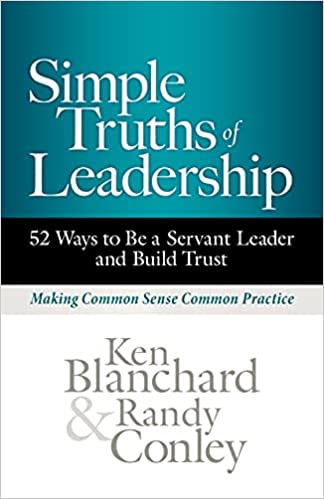
Discover practical advice that works in these essential concepts of Simple Truths of Leadership by Ken Blanchard and Randy Conley. Although we cannot cover all 52 facts, we have chosen the ones we believe will be the most helpful.
Organizations are only as effective as the individuals in charge, which is a well-known truth. A business’ and its employees’ potential can only be realized with excellent leadership. It’s simply not feasible.
Great leadership, yet, what is it?
Although it may seem paradoxical, becoming a successful leader entail serving others! Servant leadership is a style of leadership where you prioritize your team members and clients before yourself. It’s not a a skill that can be mastered easily, but getting better at it may significantly affect your team’s performance and your effectiveness as a manager.
Discover practical advice that works in these essential concepts of Simple Truths of Leadership by Ken Blanchard and Randy Conley. Although we cannot cover all 52 facts, we have chosen the ones we believe will be the most helpful.
You need to do one simple thing: listen to your heart—to choose the kind of leader you want to be. How does it say that? Does it suggest that you should work for the greater good? Or does it advise you to act only in your own self-interest without regard for the harm it could do others?
Understanding your inner motivation, can impact whether you want to be a poor leader or a servant leader.
As a servant leader, you put others before yourself by prioritizing the needs of your team and the larger business. This entails providing your team with a clear sense of direction. The servant leader team should know the outcomes they aim for and what success looks like.
This is quite typical leadership action up to this point. However, the servant leader also performs other tasks. After setting expectations for your team, assist them in achieving those objectives. Feedback and training opportunities are essential tools that can make your workers more productive and motivated. And by spending time to listen and learn what kind of assistance your workers require.
You’ll achieve outstanding outcomes and have wonderful working relationships with your team by offering strategic guidance and daily help.
Do you have a plan for the future of your business? If you want to be a great servant leader, share it with your team to inspire and motivate them to work toward a shared objective. A vision may be formed easily. But it does need to respond to three crucial queries.
What is the overarching goal of your business to start? What sort of business do you truly run, in other words? Try to go as deep as you can to uncover the solution. Think about Disney, for instance. Instead of describing itself as an entertainment corporation, Disney says they are in the “business of happiness.”
What does success look like in your organization, the second query? Your troops can reach their destination faster as long as they know what they are going for. Disney is clear about what success looks like for happy visitors when they enter and when they depart their theme parks.
What are the values of your firm? Asks the third question. These principles will direct your company toward success. Therefore, you must get them properly. Safety is Disney’s top value, followed by civility and making sure that every employee puts on a fantastic performance for the guests at its theme parks.
You’ll have a compelling vision to convey to your team once you combine these questions’ responses.
Who controls the highest levels of authority in your company? It is the leader for the majority of businesses. Additionally, everyone is responsible for responding to their needs and wishes below the leader.
However, such an arrangement needs to be corrected. Why? Because leaders should refrain from occupying the pyramid’s summit position. A different person holds the top position: your client.
The customer’s needs, not those of the big boss, drive the best firms. Everyone in your firm, regardless of their level of seniority, should try to meet your client’s demands. Additionally, they must pay close attention to the staff operating on the front lines that regularly deal with clients. The only way for great leaders to genuinely understand their consumers is by paying attention to their front-line employees.
A great leader listens to their team members and supports their initiative. Another strategy for upending the established leadership structure is this. Create an environment where everyone participates in setting the agenda rather than imposing commands from above. Consequently, accountability will pass down the chain of power, and each employee will assume leadership responsibilities independently.
Bad leaders are similar to seagulls in that they swoop in, cause a scene, dump on their team, and then quickly fly out when their subordinates won’t progress toward their objectives.
Fortunately, going from being a seagull to becoming a terrific leader is simpler than you would imagine. It all depends on a tactic called praising.
The finest leaders show up when something goes right rather than when something goes wrong. The goal of a good leader is to find something to complement their team members, not to just blame them for their mistakes. They know that praising positive conduct increases the likelihood that the individual will repeat it.
But how do you successfully provide praise? Be precise at first. When you notice someone doing well, go up to them and explain exactly what they are doing well. Tell them how appreciative you are and why their outstanding achievement is so important. Finally, tell them you are very confident in them and urge them to keep doing what they are doing. Ensure your colleagues understand how much you value them and how you will help them move forward as you close the chat.
Humans make errors, as you’re undoubtedly already aware. And your employees are no different! It is your responsibility as a leader to note the mistakes committed and take steps to prevent similar errors from occurring in the future.
Depending on an employee’s level of expertise, you should adjust your response when they make a mistake. A brief scolding is necessary if someone is performing below expectations yet has the potential to improve better. Make careful to criticize the person’s actions rather than them as a person when you scold them.
But what should you do if a performer is ineffective and unable to improve? We are all continually learning in a world that is changing quickly. Furthermore, blaming students is not fair or fruitful. It is your responsibility as a leader to redirect learners rather than correct them.
You can do this by watching their performance step-by-step and analyzing what went wrong. Ensure your colleague comprehends their objective during this evaluation and how they might better work toward it. Finally, reassure the person that this error does not define them and that you are still confident in their ability to do it correctly the next time.
Once leaders have established their style, they rarely make in changes. Just 50% of them will ever change their style of leadership. But the most effective managers understand the value of flexibility; they manage various team members in multiple ways to achieve the greatest outcomes.
Look into the characteristics of each of your subordinates before selecting how to lead them rather than using a one-size-fits-all strategy. Ask yourself specifically whether the person is skilled and how devoted they are to their work. Lead properly, then.
For instance, a committed beginning with little experience is considered to be enthusiastic. Enthusiastic newcomers require direct, unambiguous guidance and constant supervision of their actions.
A disillusioned learner, on the other hand, is just moderately proficient and shows little dedication. To perform better, this person would benefit from a leadership approach that is more coaching-like.
Last, you can be fortunate enough to have an independent achiever on your team. This person possesses both a high degree of expertise and a high degree of devotion. Self-sufficient achievers perform best under the guidance of leaders who assign duties and step aside.
Most business executives know that their primary concern should be the needs of their consumers. However, exceptional executives know that their company’s internal consumers are its most crucial. This is because they view every single employee as a customer.
Though it can initially seem strange, this makes complete sense when you think about it. Customers are extremely valuable since they help your company make money. But are your employees doing different things as well? You only have external clients because of their sales, marketing, product development, and customer service skills. Because of their dedication to their jobs, your staff members are your most vital clients.
In light of this, leaders should focus on motivating, advancing, and listening to their teams and fostering an atmosphere where their requirements are prioritized. It could feel awkward to emphasize your staff more than your clients, but remember that this strategy will result in higher client satisfaction, not worse. Your firm will grow when your workforce is content and feels supported in carrying out their duties to the best of their abilities. Ultimately, your customers are going to keep supporting you as long as you keep providing them with superior products and services.
Some leaders believe that empowering their followers entails granting them complete independence. However, effective managers know that setting boundaries for their employees is the greatest approach to instilling autonomy in them.
Are you still trying to figure it out?
Think of a river that flows quickly. This powerful river would swiftly turn into a sizable puddle if no river banks were on either side. However, with limits set in place, the water is directed to produce a strong force. Your team needs boundaries to move in the proper direction, just like a river.
How can you establish these boundaries? Most of the time, all it takes is making sure your staff members are informed. People working for you, for instance, should be clear about their objectives and what you expect of them in terms of performance and standards. Additionally, they must be well-versed in all the laws and ordinances controlling your sector.
And last but not least, make sure that everyone on your crew is familiar with the policies and practices of your business. These guidelines will set the parameters within which your staff members will work. Although they may sound boring, the river banks serve as a positive energy route for your people.
A crucial component of leadership is trust. People will be more creative, work more effectively, and have higher morale when they trust you. Conversely, if your team believes you are unreliable, they will work against you and become disengaged and less productive.
But what characteristics mark a reliable leader? They’re competent, to start. Everyone on the team has confidence in the team leader’s abilities. Second, they are morally upright. Their followers know they will follow through when they promise to accomplish anything. Not to mention that they are warm. You can rely on these managers to instill a sense of security in their staff. They are not only kind, but they also show genuine concern for the well of their populace.
Asking your coworkers will reveal a lot about how much confidence they have in you. Asking for criticism on your competency level, honesty, and interpersonal skills may seem intimidating, but be confident to do it. By exposing yourself to criticism in this way, you may not only gain useful knowledge you can use, but you’ll also be able to show your fragility. This is significant; a key component of servant leadership is allowing yourself to be vulnerable in front of your people.
Some leaders use fear as a strategy because they think followers respond better to leaders who make them uneasy. These leaders yell at followers, criticize them, and point out each small error they make. But effective leaders are aware that inciting fear seldom yields positive outcomes. The reverse is true. People don’t perform better when they are terrified of their leader. Instead, they just put forth more effort to cover up their errors. They also refrain from setting ambitious, difficult objectives since they know failure will not be accepted.
On the other hand, great leaders make a concerted effort to reduce or eradicate any anxiety among their staff members. How?
The most crucial action they take is to behave consistently. If your team can confidently predict your expected behavior in various scenarios, they will be much less fearful of you. Supporting a new employee who attempted something different but wasn’t quite successful, might encourage other staff members to take calculated risks.
Second, when employees make errors, strong leaders transform these missteps into learning opportunities and offer guidance on how to do better the next time rather than blaming their staff.
Finally, the most effective leaders are usually being more polite to reduce anxiety. “Thank you”, and “please” are some easy and everyday words you can use, and they go a long way toward improving your connection with your staff.
All successful leaders share one trait in common: integrity. Integrity is a Latin term that loosely translates to mean entire or undivided. Your whole being is in harmony when you have integrity and your words and deeds are consistent. The trust between you and your staff erodes when you behave dishonestly or speak the talk but don’t live the walk. Why? Thus, they are unable to believe anything you say anymore.
By adhering to the Five P’s of Ethical Leadership, you may conduct yourself with greater integrity. The first P stands for purpose; ethical leaders let their overarching goal guide their everyday actions. The second P stands for pride; effective leaders have a healthy sense of pride founded on self-confidence rather than being narcissistic. They have this self-assurance since they are aware of their competence. The third P is patience; ethical leaders believe that if they remain true to their core principles, things will turn out for the best. Persistence is the fourth P; a successful leader must stick with it when things go rough and adhere to their values. The last P stands for perspective; leaders with integrity maintain their selves in sync and their actions with the larger picture of their organization.
At some point, we all betray someone’s confidence, which is terrible but true. Even though this split may seem irrevocable, there is a straightforward action you may take to restart your relationship. You may apologize but there is a certain art to effective apologizing; if you want to mend the connection, you must apologize properly.
Start your apology by accepting responsibility for your actions. Don’t try to justify it or use words with conditions like “if” or “but.” These terms suggest that you are transferring responsibility. Second, express to the individual that you are aware of the grief you have caused them; do not try to downplay their pain to make yourself feel better. Allow the person some time and space to express their pain to you. Pay attention to how your activities have affected others. Finally, complete your apology by pledging not to repeat your actions. Remember that your apology only has value if you don’t repeat the act that destroyed your confidence.
This book’s main takeaway is that:
The finest bosses believe in their team members and seek to develop friendly, encouraging connections with them. Great leaders put their customers and employees first, not themselves, as the heart of the business operations.
Here is some additional useful guidance:
Share information freely because it is beneficial.
Leaders must have faith in their followers. Openly sharing information with your staff is one of the finest methods to show this trust. Information hoarding and keeping your workers in the dark may soon go south. Your workers will develop assumptions and concoct their narratives about what is happening to fill in the information gaps in their knowledge base. These tales could be depressing and detrimental to morale. Therefore, adopt a policy of providing information, speaking honestly, and being as open as possible!