Let’s begin this book with a quote: “You need both competitiveness and the capability to persist, no matter the situation, and never give up.” This quote is from soccer star Abby Wambach, whose relentless drive has propelled her to the pinnacle of the athletic world. Our society highly values grit—the determination to persevere under any circumstances—and frequently views quitting as a sign of weakness.
Optimism and perseverance can indeed sustain us through difficult times, but they can also lead us to persist in futile efforts for too long. Although perseverance is often necessary for achieving success, it doesn’t ensure that we will always reach our goals. Sometimes, we continue striving when we should actually stop, which can lead to serious consequences.
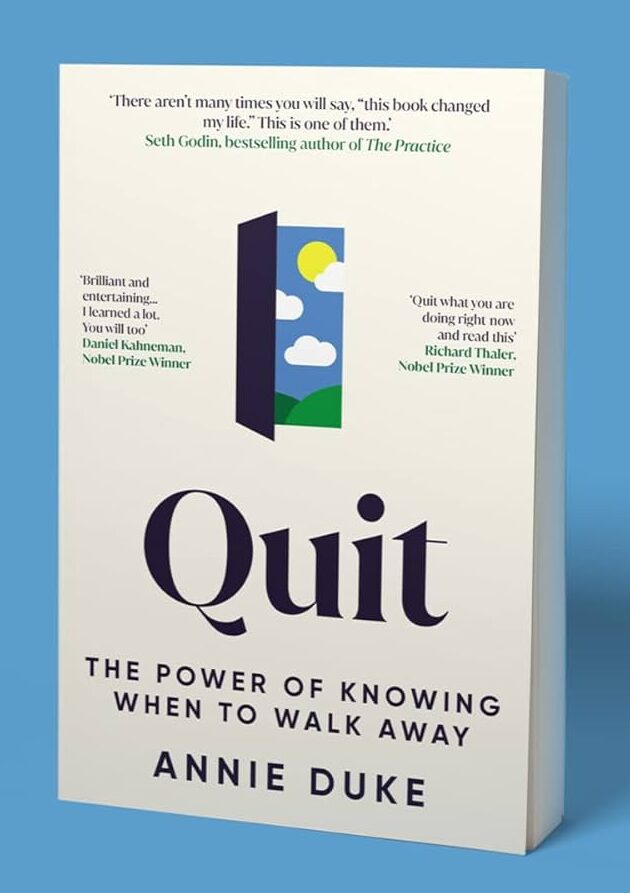
“The Quit,” by Annie Duke, will help you recognize the importance of quitting and guide you in making better decisions about when and how to do it. The book demonstrates that success isn’t about relentless persistence; it’s about identifying the right path to follow. Without this discernment, we risk wasting substantial money on a failing business or spending years in an unproductive relationship.
By learning to quit at the right moment, we can avoid enduring unnecessary hardships or squandering time and money we can’t afford to lose. This allows us to focus on pursuing what truly matters to us. So, let’s begin!
Nothing exemplifies the value of quitting quite like poker. As Kenny Rogers famously sang, knowing when to hold ’em and when to fold ’em is the essence of the game. Do professional poker players win hands through sheer grit and perseverance? Not at all. In fact, they fold more than half the time—much more often than amateurs. Poker novices, on the other hand, tend to play out their hands, driven by the hope of a miraculous straight and the fear of losing their existing bets. And how does this strategy reward them? By costing them everything.
In the story we tell about success, we tend to focus on “winners” and become captivated by inspiring success stories, such as a miraculous, last-minute straight flush. What often goes unmentioned are those who chose to stop short of their goals—what might be labeled as “failure”—and who ultimately gained from their decision. However, quitting in response to changing circumstances is a smart and essential skill.
Consider mountain climbing as an example. Every year, numerous individuals attempt the challenging ascent to the summit of Mount Everest. While some successfully reach the top, many others perish due to the mountain’s notoriously harsh conditions. In both cases, climbers showed perseverance; some achieved their goal, while others met their end.
Other climbers, however, come close to reaching the summit of the world’s tallest mountain but decide to turn back and abandon their climb due to unsafe conditions or time constraints. This decision often proves to be a life-saving choice.
One key lesson from these prudent climbers and poker experts is that quitting can indeed be a virtue and is not something to be embarrassed about. In the following sections, we will explore the advantages of quitting and discuss the best times and methods for making a graceful exit.
Stewart Butterfield’s initial ambition was to develop a successful online computer game. However, he ultimately created a highly lucrative communications tool instead. His success was made possible by his insightful decision to quit. Butterfield’s company, Tiny Speck, was well-funded with millions in investment capital and had launched a game called “Glitch” that received excellent reviews and built a dedicated, though modest, fan base.
However, his business model relied on increasing the number of subscribers. Despite a successful marketing campaign that expanded the subscriber base, Butterfield realized that the numbers didn’t add up and the company wouldn’t succeed with the existing strategy. Remarkably, even with investors still optimistic and subscriber numbers climbing, Butterfield chose to shut down the venture.
Many of us cling on for too long, battling for our goals until the very end. We do this because we fear losing out on opportunities and feel we are abandoning something we’ve invested significant effort in. However, by not quitting, we often miss out on other opportunities that we could have been pursuing.
Butterfield decided to quit, but his journey wasn’t over. He redirected the investment funds into an internal communications tool that his team had developed, known as “Slack.” He eventually sold Slack for $27.7 billion, significantly transforming team communication. So, how can you apply the power of quitting to your own life?
To determine if it’s time to quit, you can assess the expected value of your decisions. This involves a bit of mental projection. Begin by envisioning the future and estimating the possible outcomes of your choices, including both potential benefits and drawbacks. These outcomes might not solely be financial; they could also relate to factors like time, personal satisfaction, or stress levels. After evaluating these results, consider alternative ways to use your time and calculate the expected value of those options as well.
Evaluating when to quit in this way doesn’t imply that you should avoid taking risks. Significant risks can sometimes offer substantial rewards. However, it’s important to assess these risks carefully and maintain a realistic perspective. This approach was used by Butterfield and is also employed by top poker players to win millions. It could help you chart a more rewarding path.
Imagine you’re given a free ticket to an outdoor concert, but the weather forecast predicts terrible conditions. Even if you’re a fan of the band, a complimentary ticket alone probably wouldn’t make you want to endure the bad weather. However, if you’ve already purchased the ticket, you might feel compelled to attend to avoid wasting the money you spent.
Ideally, whether the ticket was free or purchased shouldn’t affect your decision, as you’d still be uncomfortable in either case. Nonetheless, you tend to view the two scenarios differently. This reflects the sunk cost fallacy: the more resources we invest, the more inclined we are to persist, even when it’s not wise. We deceive ourselves into believing that we’re preventing waste.
Another example is continuing to pursue a college degree in a field you’re not passionate about simply because you’ve already invested significant money. If you don’t quit, you’ll end up spending even more time and money, only to end up in a career you dislike. This situation is similar to an optical illusion: despite understanding the underlying issue, the illusion remains compelling and hard to ignore.
Another obstacle to making wise quitting decisions is known as escalation of commitment. Once individuals commit to a particular course of action, they often become increasingly invested, even if things aren’t going well. Instead of acknowledging their error, they persist, sometimes at great expense.
During the Vietnam War, it quickly became clear that the conflict was both expensive and unwinnable. However, leaders chose to intensify their efforts, resulting in widespread devastation and resentment. The war ultimately claimed tens of thousands of American lives and incurred a cost of $1 trillion in today’s dollars. It also had significant repercussions for political leaders and fueled public backlash against the US government.
The endowment effect, identified by Richard Thaler—the same researcher who introduced the concept of sunk cost—occurs when we place excessive value on things we own compared to those we don’t.
This sense of ownership also applies to our ideas and decisions. As we achieve milestones towards a goal or become involved in decision-making, our sense of ownership grows, amplifying the endowment effect. Additionally, we tend to favor maintaining the status quo, preferring to keep things as they are rather than change them.
For instance, if team management signs a star player to a substantial contract, it can become more challenging to bench or trade that player if she underperforms. Management feels a sense of ownership over that decision and values the player more than a comparable one who wasn’t part of such a significant investment. These factors collectively make quitting very difficult. However, being aware of these tendencies can help us navigate these challenges more effectively.
Sears was once a major retail giant. In the 1800s, it established a highly successful mail order business, serving rural customers. As retail stores became more popular, Sears adapted by shifting to that model, expanding its empire further. However, as competition increased and market conditions evolved, Sears began a prolonged and unavoidable decline.
The company had a viable alternative. In addition to its retail business, it had developed a profitable financial services division, including Allstate Insurance, Discover Card, and Coldwell Banker real estate. However, Sears did not pursue this option. Instead of moving away from a failing market, it sold these successful ventures to fund its retail operations and preserve its core identity. As you might expect, this approach eventually led to bankruptcy.
Our identities significantly influence our decision-making, and when they are deeply tied to our careers or projects, quitting can become especially challenging. Cognitive dissonance contributes to this difficulty. When faced with information or facts that conflict with our beliefs, we experience discomfort—known as dissonance. To resolve this, we can either adjust our beliefs, which may be central to our identity, or dismiss the conflicting information. Typically, we choose the latter rather than acknowledge that we were mistaken.
Compare Sears with Philips, which initially started as a light bulb manufacturer. Philips later expanded into electronics, and both areas remained significant to its business up until 2012. However, Philips also encountered a shifting market and had alternatives. With a long-standing involvement in health care, Philips chose to divest its less profitable light bulb and electronics divisions. Following this transition, the company was able to generate nearly €20 billion in annual sales. This example demonstrates that it is possible to overcome the strong influence of identity.
We’ve discussed at length how difficult it is to quit when necessary, and research indicates that avoiding these mental barriers is nearly impossible. However, we haven’t yet covered the fascinating concept of the juggling monkey. Confused? Let me explain.
Eric “Astro” Teller, an entrepreneur and academic who played a key role at Alphabet’s X division, is an expert in the art of quitting. His company specializes in ambitious projects that have the potential to transform the world and clearly prioritizes substance over creative company names. Given their substantial financial investments, they must be ready to abandon ideas that aren’t succeeding and redirect resources toward more promising ventures. If an idea cannot be brought to market and made profitable within five to ten years, it is not worth their attention.
The X team uses a vivid metaphor to evaluate projects. Imagine you want to start a traveling show with a monkey juggling flaming torches on a pedestal. While the pedestal is straightforward and might give you a false sense of progress, the real challenge is training the monkey to juggle fire. Without successfully addressing that critical aspect, the show can’t happen.
X identifies both the “monkeys” and “pedestals” in each project. The team will not proceed unless they have resolved the primary challenge.
When starting a project, it’s beneficial to establish “kill criteria,” which are specific, measurable benchmarks. If these benchmarks aren’t met, you should abandon the project. Such criteria might include a budget limit, a deadline, or securing client approval. One method for creating kill criteria is to conduct a premortem—envision the project’s failure and identify the potential warning signs. Setting these criteria will help you counter detrimental thinking, such as the sunk cost fallacy.
It may be surprising, but there have been marathon runners who, despite breaking a bone and enduring intense pain, have still managed to complete the race. While goals can be highly effective in driving us to achieve challenging tasks, they also have a significant drawback: they can cause us to overlook changing circumstances, become rigid, and even force us to stay in detrimental situations—similar to aggravating an injury by continuing to run with a broken bone.
One reason for this issue is the “finish line mentality.” This mindset suggests that only the completion of the entire goal counts as a success, viewing it as an all-or-nothing scenario. Goals with this mindset present a false dichotomy: either you complete the goal or you shouldn’t bother at all. Such goals often overlook the progress and achievements made throughout the process and are often arbitrary.
Consider it this way: runners who don’t complete a marathon might still cover the same distance as a successful 5K. Likewise, mountain climbers who come close to reaching the summit of Everest have still achieved something that few people, even experienced climbers, have managed. When we set goals like climbing mountains or other ambitious targets, our information is always incomplete—circumstances and ourselves evolve. However, our goals tend to remain rigid and unchanged.
You can maintain flexibility and realism in your goals by establishing “unless” conditions. This approach involves setting your goal while allowing for exceptions if certain circumstances arise. For example, you might aim to achieve a goal unless A, B, or C occurs, such as if your partner isn’t interested in commitment or if you’re not generating a profit by the third year. Keep this in mind the next time you’re tempted to push through despite significant obstacles.
The key message of this book is that our fear of quitting often stems from a fear of failure and a concern about wasting the valuable resources we’ve invested. However, it’s important to understand that our perceptions of failure and waste might be incorrect. Being able to walk away from situations that no longer serve your interests is a crucial skill. Even if you’re currently content, remain open to alternative opportunities, as circumstances can shift. You might discover that quitting can actually lead you to greater success.
Actionable advice:
Consider hiring a quitting coach!
Has anyone ever said to you, after you’ve finally left a dreadful job, that they knew you’d been unhappy for months but didn’t say anything to avoid hurting your feelings?
Quitting can be challenging, and an external viewpoint can help you address your biases and rationalizations. This is where a “quitting coach” can be invaluable—a person who will provide honest feedback and assist you in finding the best course of action. Although the truth might be difficult to hear, it can ultimately prevent future difficulties.