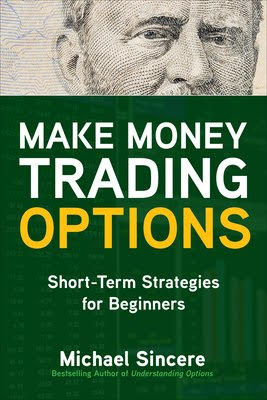
What you’ll pick up from this book:
People frequently lament the fact that they did not take advantage of lucrative investment opportunities.
But the dangers involved and the money that could go in an instant are glossed over. The chance at financial success is just too appealing to pass up.
We will teach you how to manage your risks instead of gambling away your life’s wealth on long shots. You will learn to go with the flow rather than try to buck the system. You won’t get rich quick by trading stock options, but if you play it safe, you might find the means to steadily increase your income.
The market ultimately prevails, and you should expect to not make a profit on every trade. But with these aids, your losses will be minimal.
What you’ll pick up from this synopsis
Let’s pretend you’ve recently retired from a long and successful career in education. You’ve been putting away a small portion of each paycheck into your retirement fund for a while now. Your $150k deposit is now a sizable retirement fund.
The trouble is, though, you have some very ambitious goals set for when you do retire. You dream of going to nice hotels all around the world and eventually being able to pay off your mortgage. So, what are some ways you might boost your earnings?
You instantly think of the stock market. Then you go back to how your nephew constantly brags about the sums of money he generates through a practice known as trading options. In my experience, he always comes out on top. What have you got to lose by giving it a try?
The takeaway lesson is that trading stock options can be a successful way to make money.
One thing your nephew has said is true: you can profit from trading options. There is, nevertheless, the possibility of loss, as there is with any investment. Let’s break down the elements that make up our selections so we know what’s at stake.
An option contract is the legal term for a stock option. You are not compelled to buy the stock at the strike price, but you do gain the right to buy or sell shares at that price in the future.
You presumably already know how stocks function. At the current price of $10 per share, you can own a very small portion of Microsoft. At a price of $15 a share, you’ll have a nice profit of $5 if you decide to sell your Microsoft stock.
However, if the share price drops to $1 and you decide to sell, you will lose the difference, or $9. The first investment for 100 shares would be $1,000. And if the market tanks, you stand to lose $900.
Options purchasers are not obligated to purchase the underlying shares. One option contract gives you control of 100 shares, so you can get started with considerably less capital than in stock trading. This contract may include premiums that are only a few dollars.
Suppose you invest in a Microsoft option contract at a cost of $10 per share. At $15, you’ll have the option to buy 100 shares of Microsoft at the lower strike price and then sell them at the higher market price. That means you’ll have $500 in your bank account rather than a $5 profit. Only the premium you paid will be lost if the price drops to $1.
I must admit, the prospect of a foolproof way to amass wealth quickly is really appealing. Where could we possibly go wrong, if at all?
There are several things that could go wrong in the first scenario.
For the sake of making a fast buck, many inexperienced traders continue to confuse options with stocks. They intend to buy 50 shares but end up with 50 options instead.
Keep in mind that a single option gives you power over 100 shares. Buying 50 options is equivalent to selling 5,000 shares. You could win tons of money, but if you lose, you could lose hundreds or even thousands.
Indeed, this is one of the major risks involved with trading options. A large portion of your savings could be wiped out in a matter of hours or even minutes if you are not diligent and do not know how much money is at risk before joining a deal.
The implication is this: An understanding of option mechanics is crucial for reducing exposure to risk.
The judgements you make while buying and selling stocks for profit hinge on your assessment of the future performance of the market. There is an option type for both an increase and a decrease in share price.
In this hypothetical scenario, Apple is presenting a brand-new iPhone model. You have full faith that it will be a smashing success and that Apple stock will soar as a result. However, there is one catch: you can never know for sure. What if there’s a report that reveals a security hole? The result on the stock market would be catastrophic.
A call option contract can be purchased as a hedge against potential loss of capital. 100 Apple shares at the pre-announcement price would be worth it if the new iPhone is perfect and the share price rises. It’s also possible to sell the option to someone else who is interested in purchasing the shares at a lower price. The value of your call option rises in tandem with the stock price.
Bets against the market are what make the second sort of option a little more complex. If you acquire a share of stock for $10 and it drops in value to $1, you are out the full $10. You have the option of selling now to minimize your losses, or holding onto the stock until its value rises again.
But let’s say you’re of the opinion that stock prices are about to crash. Purchasing a put option will still allow you to profit. This grants you the option, but not the requirement, to sell Apple stock at a predetermined price, such as $5, regardless of the current market price of the stock.
For the sake of this discussion, we will only consider call options.
After reading this, you should feel more prepared to start using call and put options. In theory, it’s not too difficult, so long as you don’t mix up shares with options and maintain tabs on your potential loss.
However, there is a further distinction between stocks and options that might have a significant impact on your long-term gains or losses.
You can either trade the stock frequently or hold it for the long haul when you make a purchase. You could, for instance, invest $50 in 50 shares of Google stock and forget about it. Just go on a vacation already. Sign up for a knitting group!
If the business is still around when you get back, so will your shares. However, the time starts ticking the moment you purchase an option.
Important takeaway: unlike stocks, options eventually become worthless.
As with life, one’s options eventually expire. At the time of purchase, you specify the expiration date for your choice. Most options have a deadline of 4:00 PM Eastern Time on the third Friday of every month. Scheduled expiration dates range from weekly to quarterly.
If the option’s expiration date is far in the future, you should expect to pay a higher price. The option’s selling price drops precipitously as the expiration date draws near. The option’s appeal decreases when the window of opportunity for a large stock price swing narrows.
Because of this, even with accurate market forecasting, options trading might result in a loss for certain investors. Waiting until the last possible moment to sell (or quit) an option position can be extremely dangerous. The premium you receive may be less than what you paid for the option, even if the underlying stock price has increased.
Here’s a possible scenario. You believe that the market price of a Netflix share will rise to above $25 in the next few weeks from its current level of $20. As such, you invest $10 in a single call option with a monthly expiration date. The goal is to find someone willing to pay $20 (the strike price) for 100 shares of stock and sell them an option to do so. You have no choice except to sit tight and keep your ears open.
After fourteen days, Netflix stock is trading at close to $18. Sadly, you no longer have any faith. Your wishes come true two days before your call option expires when the share price hits $25. Because of the short time left before its expiration, the premium on your option has dropped to a mere $2, but someone still buys it.
Even though you correctly predicted the outcome, you still lost money.
Options trading can seem difficult due to the inherent risks and complexity involved. However, if handled properly, options can be a fantastic method to boost your earnings and savings.
In some situations, when betting on a horse race, after the starting gun goes off, you cannot alter your wager.
Instead, you bet on the top three finishers in the race. If your guess is correct, you get a financial reward. Furthermore, if you are incorrect, you will forfeit your wager.
If you didn’t have to take such big risks, would you?
You would have a better chance of winning if you could, say, bet halfway through the race. While the Test Trading Strategy isn’t permitted in most horse races, it is legal when trading options.
Is this the main point? Use the Test Trading Strategy to zero in on the most promising stock picks.
So you can’t predict the future, and that’s fine. Instead of guessing where the market is headed, you may put your thoughts about stock prices to the test with virtual trading tools.
Practice buying and selling stocks and options with virtual money, popularly known as “paper trading.” As an educational tool, paper trading is invaluable; but when coupled with live trading, it can help you avoid costly mistakes and unexpected losses.
You can use the Test Trading Strategy to be ready for the day, pick stocks to keep an eye on, and plan which days to skip trading. Because, obviously, not every day is a good day to trade.
The first step is to open a demo trading account. It’s possible that your current broker offers a practice trading platform of her own. If not, there are a plethora of alternative resources, such as Investopedia, that may be accessed without cost.
Assuming you have successfully established a test account, you may proceed with the creation of a Watch List. This is the group of stocks and other investments (such Exchange Traded Funds) that you’ll keep an eye on via your computer or mobile device.
SPY is the ticker symbol for SPDR S&P 500 ETF Trust and should be added to your list of stocks to keep an eye on. Include the Invesco QQQ Trust (QQQ), the Dow Jones Industrial Average (DJIA), and the Standard & Poor’s 500 Index (SPX, S&P 500) on your list.
You can use these exchange-traded funds (ETFs) to monitor broad market movements; next, diversify into specific stocks. The following part of this article will teach us how to do it.
The stocks you add to your Watch List should satisfy certain requirements. It’s important to keep in mind that these are the organizations whose shares (or options) you’re contemplating trading.
These stocks need to be among the most actively traded on the market and have a price per share of at least $50. Mutual funds, indexes, banks, and hedge funds are all suitable places to keep them. Many of the world’s most successful businesses, such as Apple, Amazon, IBM, Mastercard, Netflix, or Tesla, populate a robust Watch List.
Investments that are high-risk or that can’t be easily converted to cash, like American Depositary Receipts (ADRs), should not be included on your list.
You can start making mock transactions after importing your Watch List into a practice trading account.
The takeaway is as follows: Create a Watch List and add individual stocks to it. Then, begin practicing trading.
It’s a good idea to spend a few minutes setting up your demo trading account and adjusting your settings before the real market opens and trading begins at 9:30 a.m. Eastern Time. It is recommended that you start your paper account with at least $100,000 so that you have enough room to try out various strategies and buy a wide variety of stocks while using a trading simulator.
You should check the stock quotes on your Watch List about 30 minutes before the market begins. You can use them to predict the future of the market. Is there a one dollar or one percent increase in Mastercard stock? Isn’t Tesla a big deal?
You can’t buy options before the market starts, but you can place an order to acquire 100 shares of each stock in the demo trading account. After 9:30 AM, this should be a market order, which means you will be charged the going rate per share when your order is filled.
It’s up to you whether you want to look at changes in actual dollars or in percentages. You should focus on locating profitable stock investments.
Finally, investors should be wary of stocks that show big pre-market gains, as a surge of eight or nine percent is not necessarily indicative of further gains for the stock.
Once the stock market begins, your goal is to look intently for stocks that reverse course or don’t keep up. The true victors will emerge eventually.
At 9:30 in the morning, the starting gun is fired. You can start to sort the wheat from the chaff in real time by monitoring the stocks you’ve bought in your trading account.
It’s easy to get carried away by the juggling act that is the stock market first thing in the morning. Some equities will soar, some will fall, and still others won’t budge at all. True winners will become more apparent with more stable increases as the morning develops.
Patience is required at this point, but so is knowing what to look for. To what extent do positive traits such as these determine success?
The main point is to identify profitable stock investments as soon as the market opens.
Buying cheap and selling high is a frequent trading strategy. The facts reveal that this is extremely challenging to accomplish, and that timing miracles of this sort are extremely rare to repeat.
As an alternative, you can locate the continuously rising stocks in the first hour using the Test Trading Strategy, and make smaller profits by buying high and selling higher. When there are no obvious winners by midday, it is appropriate to call it a day.
There ought to be a couple of clear front-runners that you can single out from the bunch. There are days when as many as six or seven appear. The demo trading account is now ready for call purchases.
An approach known as the “five-call probe” will be used. Invest in five call options on any stock that has a chance of success. Call options are considered to be in-the-money when their purchase price is less than the current market price of the underlying stock. By keeping an eye on these predictions and the accompanying stocks, we can identify which of the early leaders will maintain their lead.
If the value of your options continues to rise, you should buy five more calls at the market price. If these calls are likewise profitable, netting you $100-$300, you’re ready to graduate from the trading simulator to the real world and begin purchasing call options from a brokerage.
Before you go ahead and purchase call options on each winning stock in your real brokerage account, there is one last thing to verify.
You’re ready to stop practicing with fake money and start trading with real cash. Dot your i’s and cross your t’s, or you can be in for some unpleasant and costly surprises. When it comes to money, surprises can be thrilling — but not if they cost you a lot.
The Five-Minute Rule is designed for just such an occasion. By following the procedure outlined above before each deal, you may ensure that everything is in order before pressing the Enter key.
One of its best features is that you won’t miss out on any major market shifts because of the short time commitment.
The main takeaway is that the Five-Minute Rule can be used to mitigate losses in real options trading.
As a newbie, you should only hold one or two open positions (unsold or unused options) at any given moment. The number of available seats in a game can quickly become overwhelming if not kept track of. You can begin working on the Five-Minute Rule once you’ve selected which post to fill.
To begin with, it’s important to read the option’s fine print. This requires double-checking the contract’s end date and striking price. The options chain is the place to find all of this data. This is where many traders fall into trouble: The situation becomes problematic if one accidentally signs up for a hundred phone contracts instead of ten or one.
After that, look at the range between the greatest price a buyer is willing to pay and the lowest price a seller is willing to accept, known as the bid-ask price. The options chain also includes this. Try trading another stock if the difference between the bid and the ask price is too significant. If the spread between the ask and bid prices is too large, it will be difficult to conduct a profitable exchange.
Your third action should be to use a limit order rather than a market order. To refresh your memory, in the demo account we executed a market order. Simply keeping tabs on stock prices was the only reason. Investing at market price poses a high degree of risk in a real account. Instead, you can set your own price with a limit order, which should fall between the current bid and ask prices.
Finally, double-check the stock charts to make sure your original conclusions still hold.
Taking an extra five minutes never hurts, especially if it means not jumping into a risky trade out of haste.
You have found a stock that is heading upward and have decided to buy a call option. The Test Trading Strategy is not risk-free, but then again, neither are any investment strategies.
It’s possible that the stock you’re considering has satisfied all of your criteria. Maybe it made it through your five-call investigations, and with the help of your Five-Minute Rule checklist, you can rest easy.
The truth is, no matter how many studies you do, there’s always a chance that a stock that’s been trending upwards will start to fall. Sometimes, even the pros choose the wrong stock.
You should plan for the worst, but hold out hope for the best.
The main point is as follows: After an option trade, risk management should continue.
Options trading is not for the faint of heart. You’ve just purchased a profitable call option, but contingency plans should be in place just in case. In order to achieve this goal, we make use of two different tools: time pauses and stop-losses.
Distractions following a trade result in losses for even the most careful investors.
By scheduling a sale of your option at a predetermined period, you can limit your potential loss or gain. After half an hour, or even overnight, depending on your preference. Depending on your strategy, you can either lock in profits or prevent losses from ballooning during the day.
One alternative is to use a stop-loss order. Stop-loss orders sell the option automatically when its price hits a predetermined level, rather than at a predetermined period. Even if you’re out for a stroll or at the grocery store when your stop-loss is triggered—and you don’t want to lose more than $50 on an option trade—you won’t incur any further losses.
It is up to you to decide whether a time stop or a stop-loss should be used.
You’ve already taken the necessary precautions by purchasing a call option, but there’s still one last thing to do before you can call it a day in the markets. Before you shut down your computer when the market closes, it’s a good idea to review the day’s transactions. Make a record of everything you accomplish and everything that goes wrong. In what ways were you successful in trading? Why? What were your unprofitable trades? You may improve as an options trader by looking back on your past performance and taking note of both your failures and successes.
This, then, is the central point:
Though potentially lucrative, foolish mistakes are common in the options trading industry. Due to insufficient knowledge, many novice traders experience significant losses when trading options. Use the Test Trading Strategy to find out which stocks are bringing in the most money every day. You can learn to trade options profitably without gambling away your life savings by studying the winners through paper trading and adhering to the Five-Minute Rule to avoid careless blunders before each deal.
Practical suggestions:
Don’t engage in retaliatory trades.
Some options develop a strong sentimental attachment to a particular option because of its high expected return. This may ruin the rest of their day’s or week’s worth of trading.
These emotional investors lose money in a trade and swear vengeance. They will be preoccupied with recouping previous losses by reinvesting in the same stock. This typically results in a string of rash investments that only compound the original loss.
You should just let a trading loss sit there, take a break, then continue on.