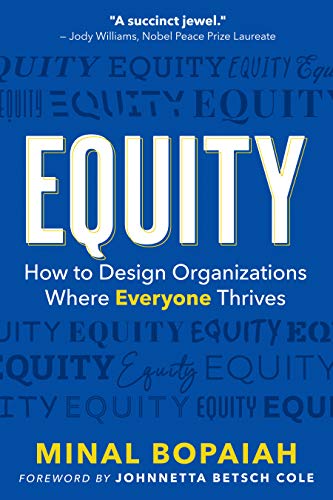
This book will teach you why putting yourself in other people’s shoes is actually a terrible way to be empathetic, why moral hand-wringing is not the most effective way to promote lasting social change, and how insights from the design world can help us craft more human-centered systems.
Diversity, equality, and inclusion, or DEI, has recently gained some traction as a catchphrase. Leaders who are socially conscious and are rushing to fill jobs with more women and people of minorities call it that.
Although it only addresses the diversity and inclusion aspects of DEI, this is a fantastic place to start. Equity, the intermediate term, frequently receives shortchange. Equity guarantees that all employees have equal opportunities to succeed, which makes this a challenge.
Therefore, this book is for you if you’re a leader or just someone who is enthusiastic about advancing justice. They will show you how to identify systemic bias in your workplace and how to establish an environment that supports everyone’s success.
This book will teach you why putting yourself in other people’s shoes is actually a terrible way to be empathetic, why moral hand-wringing is not the most effective way to promote lasting social change, and how insights from the design world can help us craft more human-centered systems.
These days, it seems that every manager has heard the terms “diversity” and “inclusion.” However, what about equity, the middle child in the DEI acronym? Why does it get so little attention in social justice discourse?
One response is that equity is often taken to be synonymous with equality and doesn’t require further explanation. However, these are actually two distinct ideas. Ensuring that all individuals have equal access to resources, such as equal compensation, rights, and legal recognition, is the essence of equality. Contrarily, equity focuses on allowing for diversity. When everyone has access to what they individually need to prosper, in accordance with their own distinct definition of success, then society is equal.
That’s why, absent equality, advocating for diversity and inclusion is a meaningless gesture. It is not sufficient to appoint individuals from underrepresented backgrounds to positions; you also need to create institutions that value individual diversity. You need to approach things systemically if you want to build an organization that is really inclusive and fair.
The main takeaway from this is that we need to recognize the inherent unfairness in our systems.
The widespread misconception that personal effort alone determines one’s level of success or failure in life is one of the biggest barriers to systemic change in the US. Because systems and institutions have such a strong hold on us, it is difficult for us to see how they affect every aspect of our life.
Now let’s talk about the US educational system. In America, municipal property taxes determine how much money a school gets. This funding mechanism is distinct, but not in a positive sense. In the majority of other nations, tax revenue is distributed equitably to support education at the national level. Every school, regardless of location, receives the same amount.
However, not in the US. In America, school funding increases with community wealth.
This system’s fundamental flaw is inequality. To put it plainly, the system works to keep the rich richer and the poor poorer.
The US also has a problem with wealth distribution along racial lines. Within white communities, the majority of the assets are concentrated. This implies that white students have a higher likelihood of attending schools with greater funding.
Racial divides are further cemented by the American educational system in this manner. Fairness was ingrained in the foundation of the US educational system, regardless of the intentions of those who built the country’s educational institutions.
Not everything is lost, though. Systems can be redesigned for equity, just as they have been constructed for injustice.
How would one describe the typical American? If you’re like the majority of Americans who grew up in the country, you were most likely raised to think of him (and most have been raised to believe it’s a “he”) as heterosexual, white, and physically fit.
Many still view every other body type as an unusual variation on this basic formula.
This is not a shocking discovery. The majority of the laws that govern America were created by white men. Moreover, the majority of the individuals we see in movies and television shows these days are, surprise!, white men. Though white men continue to be disproportionately represented in US society, the balance has recently improved.
Organizations that are built to support human diversity rather than simply one kind of person are necessary if we are to achieve greater justice. We may learn from the practice of human-centered design in order to achieve this.
The main takeaway from this is that by studying human-centered design, we can counteract systemic prejudice.
The design process that is being used the most frequently is the human-centered approach. The end user’s wants and experiences are the main focus.
The fact that proponents of human-centered design involve consumers throughout the entire process is what makes it unique. Future users are encouraged to participate at every level, from coming up with ideas to testing prototypes to offering feedback.
The nonprofit organization Embrace decided to build a low-cost incubator for premature children using this technology. The device was made to function in an Indian environment.
India has a high rate of newborn death. The fact that many Indian women give birth in their homes, distant from medical facilities, is one of the causes of this. Embrace chose a strategy that was focused on people. To assist them in prototyping a new type of incubator, its personnel invited Indian moms and doctors.
They developed a cutting-edge design that was battery-free, lightweight, and transportable. Hundreds of thousands of lives have already been saved by the Embrace incubator.
Human-centered design is only effective when the target user is understood. But what exactly is empathy? Many of us believe that empathy simply entails placing oneself in the position of another. However, studies indicate that this strategy is ineffective. In reality, what occurs when we pretend to be putting ourselves in another person’s shoes is that we combine our preconceived notions about them with our opinions about them.
However, genuine empathy isn’t a mystery. It just involves being open to conversing with others and hearing what they have to say. It really is that easy.
Leadership that is committed to equity is the first step in redesigning an organization. Every well-meaning equity project will fail if the program’s senior authorities aren’t supportive of it.
This is due to the fact that leaders are in a unique position to decide things that have an impact on the entire company. They have the power to affect values and structures alike. Executives can also have an impact on the sector as a whole because they frequently have ties with other prominent figures in the field.
What then does equitable and engaged leadership look like?
Well, any equitable leader needs to fulfill three requirements. This individual needs to be morally upright, able to recognize systems, and modest enough to admit the ways in which systemic advantages have aided in their own achievements.
The main takeaway from this is that fair leaders approach change with a systemic mindset.
The first prerequisite for egalitarian leadership is having the correct motivations. This entails treating every member of your staff and consumer with decency, justice, and openness. More significantly, though, it entails understanding the significance of diversity.
Equitable leaders are aware that there are multiple approaches to a problem. Additionally, they are aware that allowing workers to play to their strengths helps organizations. This is the antithesis of turning individuals into inflexible statuettes of the “perfect” worker.
Humility is the second requirement for equitable leadership. Equitable leaders understand that their advantages over others may be the reason for their success. Maybe they attended a good school, came from a wealthy family, or they are just in excellent health. Not everyone has experienced the same beginning in life. Leaders may be motivated by this information to provide voice to individuals who find it difficult to be heard.
This brings us to the third requirement for fair leadership: acknowledging this structural advantage in public. The misconception that success solely depends on hard work is the biggest barrier to tackling systemic inequality. Replicating this narrative is hardly an equitable leadership style. Rather, share your story in a way that exposes injustice by pointing out the institutional benefits that have gotten you this far.
It takes a lot of bravery to own up to your privilege for the benefit of others, but doing so is a commendable act that supports an organizational commitment to systemic change.
Many managers make the mistake of believing that assigning the appropriate individuals to the appropriate roles will automatically increase system equity. The narrative is that if we increase the number of women in leadership posts, then future high-level positions will naturally become more accessible to women. Sadly, that is wishful thinking.
It’s ironic that managers who say they embrace diversity also advocate for measures that undermine it. For example, a lot of executives claim to be in favor of harassment-free work environments, but many often advocate for open-plan offices, which research indicates make women feel scrutinized and watched.
Or think about how managers say they want to hire more women, but then set up the office with beer kegs and foosball tables like it’s a frat house.
Hiring and promoting women will continue to be difficult if firms continue to support policies that don’t take women’s demands into account. It is not necessary for us to fight for equity. All that’s required is the creation of systems that make equity simple.
The main takeaway from this is that organizations may be restructured to easily achieve equitable results.
Among designers, it’s a bit of a cliche that excellent design should be felt rather than just observed.
It is important that we approach system design with the same mindset. Without even considering it, we seek equitable outcomes.
How then do we go about doing that?
Using nudges, or gentle reminders that nudge individuals in the right direction, is one tactic. A gentle prod might be easy. It could entail hanging a sign in a conference room reminding participants to face the camera at all times so that hard-of-hearing coworkers can lip-read. Alternatively, it can entail selecting video conferencing software that shows participants’ pronouns so staff members are constantly aware of how to address one another.
Automating the decision-making process is another method for eliminating bias. For instance, you may implement a system whereby all employees receive automatic promotions after, say, three years of service, rather than leaving promotions and raises up to the management.
There are numerous ways to incorporate equity into systems design. However, they all typically entail streamlining decision-making and making fair behavior the norm.
We must discuss communication, which is yet another crucial factor influencing equity. Developing their internal communication skills can help leaders in their organization facilitate positive transformation.
This entails, on the one hand, being mindful of the language you use. It should go without saying that the language you choose to use is inclusive and courteous. However, egalitarian communication is much more than merely speaking in politically acceptable language.
The way you use words to call attention to structural injustice and promote change is significantly more significant. A strategy called behavioral change communication, or BCC, is something you can study. It’s been applied to promote condom use and hand washing as public health measures.
Additionally helpful in the workplace, BCC can assist leaders in fostering fair and socially inclusive behavior.
The main takeaway from this is that constructive behavioral change may be reinforced through effective communication.
Determine the barriers to change as the first step in the BCC formula. Risk perception is a well-known psychological barrier to learning new behaviors. That is, people are less inclined to take action if they don’t believe that a problem—like climate change—will put them in danger.
The next stage is to frame the message after you are aware of the challenges you are attempting to overcome. Studies have demonstrated that depending on how information is presented, people will either receive it or not. Framing facilitates overcoming psychological obstacles.
In the case of climate change, stressing how everyone is currently impacted by global warming is a useful way to get past the impacts of risk perception. Furthermore, even though these are merely two names for the same concept, the public in America supports “carbon offsets” more than “carbon taxes.”
The third step is to focus on the behavior you wish to alter. Motivating others to act is the goal of targeting. All you have to do is ask to do that. For instance, you may suggest that individuals carpool to work in order to lessen their carbon footprint. Or, in an effort to cut down on the amount of air miles the business travels, you may propose that going forward, the majority of foreign meetings be held virtually. Make sure you provide evidence for your request by illustrating how everyone’s participation would make the world a better place.
The concept of behavioral change communication can also be applied to external communications, but we’ll discuss it in the following major idea.
Although you may not consider your company to be a media company, you really must to! Media is far more than simply news and entertainment; it’s everything that we consume on the internet, including advertisements, images, and tweets.
Thus, your company is still a part of the media ecosystem even if it merely maintains a social media presence. This implies that the messages you spread are your responsibility.
Apply the REACH model to your marketing output to guarantee that it consistently conveys a good and inclusive message. Representation, experience, accessibility, compensation, and harm reduction are all included in the acronym REACH. It’s an excellent tool for pre-posting your marketing materials for screening.
This case’s main takeaway is to make sure that marketing materials are conveying good messages.
The first thing you should do is see if the various ethnic groups, genders, and body shapes are represented in your media content. It’s also critical that, in representing people, you do not unintentionally perpetuate any unfavorable preconceptions.
For instance, take into consideration that traditional marketers typically steer clear of using minority accents in their material. Everyone has a bias for those who sound like them. Marketers, however, perpetuate cultural prejudices about which accents are normal or authoritative and which are not by routinely highlighting some accents while ignoring others. Fair marketers ought to deliberately stay away from this snare.
Next, constantly question yourself, “Do I really have the right experience to be addressing this issue?” when you are generating content. If not, you can consider including others who do in your creative process.
The third review focuses on accessibility. Since one in five Americans has a disability, creating material that is accessible to all audiences is not just morally required, but also smart business. Using alt text, which is metadata that enables screen-reader software to describe photos to visually impaired individuals, on your website is an example of accessibility.
Ensure that everyone who contributes to the creation of content gets paid fairly. It’s critical that marginalized populations participate in the creative process and receive compensation, in addition to the former. This covers payment for any photos or narratives they may have contributed.
And lastly, consider the following: Does anyone find this stuff harmful? To preserve your sources’ privacy, you could, for instance, wish to think about granting them the ability to withdraw the usage of their photos or other personal information.
The goal of equitable marketing is to provide information that is inclusive, polite, and easily readable by everybody. Before they start distributing their work, they consider the possible outcomes as well.
The main takeaway from this book is that leaders should give equal system and process design more consideration if they wish to create inclusive and equitable organizations. Employing diverse and competent staff will become second nature to executives who design for equity. Because the younger generation increasingly considers social justice and ecological issues to be imperative, equity is also essential to an organization’s success. In the twenty-first century, a leader’s capacity to draw talent, keep consumers, and maintain profitability will be directly impacted by the moral decisions they make now.
Practical advice: Apply pressure on your superiors to implement improvements.
You still have the ability to advocate for change, regardless of your income or position in the company. Putting pressure on your superiors to advocate equitable policies is one method you can effect change. There are ways for you to take issues into your own hands if your managers aren’t paying attention or aren’t on board. For instance, you may plan a walkout, much like the Wayfair workers did in 2019. A protest against the company’s strategy of providing beds to migrant detention centers was demonstrated by five hundred people who marched out of the Boston offices. Use the power that is within you to bring about change!