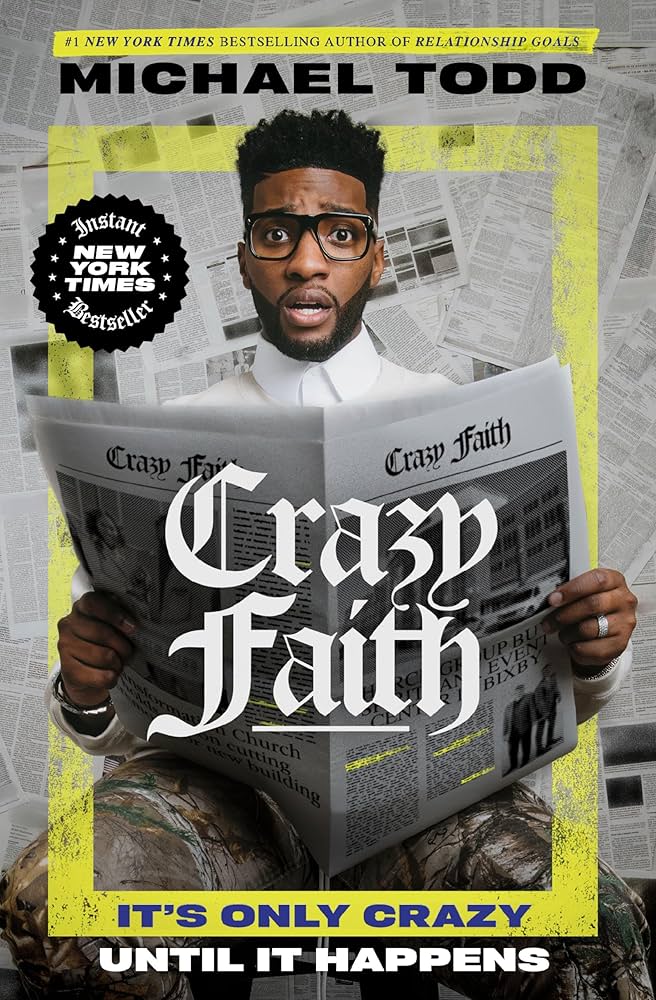
In the pages ahead, you’ll discover:
Do you yearn for a life that’s bigger, better, or more fulfilling? Maybe you dream of launching your own business or meeting that special someone, but something always seems to stand in your way.
This book is here to help you see how God can guide you past the obstacles holding you back. Whether you’re facing self-doubt, a lack of resources, or even procrastination, it serves as your ultimate faith-based roadmap.
Filled with inspiring Bible stories and teachings, this guide shows how to apply God’s wisdom to the challenges of modern life. You’ll uncover practical ways to connect with God and learn why His guidance is the key to creating the life you’ve always desired.
In the pages ahead, you’ll discover:
Picture yourself transported back to 1899, standing on a bustling train platform. You tell the crowd that in just a few years, someone will invent a machine—essentially a metal bird—that will carry them through the skies. It will be called an airplane. How do you think they’d respond? Most likely, they’d dismiss you as delusional.
Now fast-forward to 1950 in the segregated southern United States. At a time when Black Americans were barred from sharing basic public spaces with white people, imagine telling a group of white individuals that, in the future, Black and white children would attend the same schools and even marry one another. They wouldn’t just think you were crazy—they might react with hostility.
Here’s the core message: unwavering, “crazy” faith makes the impossible possible.
The fact is, both of these “crazy” predictions—air travel and the end of legalized racial segregation—came true. What seemed unthinkable in one era became undeniable reality in another. So, what about you? How can you achieve the seemingly impossible in your own life?
The answer lies in cultivating crazy faith. At its heart, faith means trusting in what you can’t yet see or prove. Maybe you believe in finding a loving, healthy relationship even after years of heartbreak. Or perhaps you’re confident that you’ll leave a legacy of wealth for your grandchildren, even if you grew up in poverty.
To build this kind of transformative faith, you need to rethink your foundation.
Many of us live with shaky foundations of fear, doubt, or misguided beliefs. But just as architects design skyscrapers with deep, solid foundations—extending stories underground to withstand wind, rain, and shifting earth—you too can create a sturdy foundation for your life. This begins by grounding yourself in the word of God and trusting His plan for you.
In the sections ahead, we’ll uncover how crazy faith can propel you to greater heights than you ever imagined.
Just as we learn to crawl before we can walk, the journey to crazy faith begins with small, deliberate steps. The author refers to this initial phase as baby faith—a time of starting small and building momentum toward something greater.
Consider how we approach other areas of life: When you begin weightlifting, you don’t start with the heaviest weights. Similarly, when the author first met his wife, he didn’t immediately profess eternal love. Instead, he invested time in getting to know her, making her laugh, and gradually building their relationship.
Here’s the central idea: crazy faith is reached by taking baby steps.
Small, consistent actions help you develop the patience and dedication needed for bigger achievements. The challenge is that many of us resist this process. We’re conditioned by modern convenience to crave instant results—like microwaving leftovers instead of preparing a slow-cooked meal. But when it comes to fulfilling your deepest dreams, there are no shortcuts.
Take the story of Noah as an example. Building the ark to save humanity didn’t begin with animals lining up two by two. It began with a single act of baby faith: Noah picking up an axe and cutting down the first tree. While everyone wants to be safely aboard the ark when the rain falls, few are willing to do the hard work of chopping down an entire forest. Similarly, we often desire God’s blessings without committing to the small, faithful steps that lead to them.
So how can you embrace baby faith? It starts by daring to imagine a life better than the one you have now, and trusting that God will guide you there in His time.
Picture yourself in your dream destination, with someone you love, enjoying your favorite drink. No matter your current circumstances—whether you’re unwell, struggling financially, or even behind bars—believe that you can reach that place. Faith begins with the courage to take the first step, trusting that each small move brings you closer to the life you’re meant to live.
As a pastor, the author frequently encounters recurring questions from his congregation: How can I be sure God is real? How do I know my future is secure? His response may seem unexpected: we can’t be completely sure. Faith doesn’t offer certainty about God’s existence or a perfectly mapped-out future.
The key takeaway is this: faith in God often feels like one big maybe.
How do you interpret the word maybe? For many, it’s a polite way of saying no. But the author challenges this perspective, suggesting we reframe maybe as a sign of possibility. The next time you hear maybe, imagine it means yes; just maybe, a miracle is waiting to unfold.
Faith thrives in uncertainty, beginning where certainty ends. When we’re completely sure of something, there’s no room for trust in God. Faith requires stepping into the unknown and embracing the mysteries of God’s ways, which often defy human understanding. As Isaiah 55:8–9 reminds us, God declares, “My thoughts are nothing like your thoughts, and my ways are far beyond anything you could imagine.”
So, when you find yourself clinging to the hope that something incredible could happen, treasure that feeling. Uncertainty doesn’t weaken your faith—it strengthens it. The journey to your destiny often begins in darkness, but God will illuminate the path step by step. That’s the beauty of what the author calls maybe faith.
This concept is grounded in the author’s 51 percent rule: you only need 51 percent belief to commit fully. Think of a presidential election—51 percent of the vote is enough to win. Similarly, you don’t need perfect faith to move forward; you just need to lean slightly more toward belief than doubt. This is why the author lives by the mantra: progression, not perfection.
Faith isn’t about having all the answers; it’s about trusting God enough to take the next step, even when the future feels uncertain.
Even those closest to us can fall short when we need them most. Take the night of the Last Supper as an example. Jesus, knowing one of His disciples would betray Him, sought comfort from His three closest friends—Peter, James, and John. He asked them to accompany Him to the Garden of Gethsemane. But as Jesus walked deeper into the garden, He turned back to find them asleep. They cared deeply for Him, but in that moment, they gave in to the weakness of their flesh—a perfect illustration of what the author calls lazy faith.
The key point here is: when we act in lazy faith, we fail to carry out God’s plan for us.
We all experience moments of laziness, and none of us is perfect. But lazy faith becomes dangerous when it prevents us from walking the path God has set before us.
Consider someone with a dream to start their own business, confident that God has called them to this purpose. Yet, instead of taking steps like budgeting, saving, or working diligently, they remain passive. When questioned about their lack of effort, they might claim they’re unsure of their abilities and are waiting for God to give them a clearer sign or more motivation.
The reality is, God has already equipped them with the inspiration they need—it’s up to them to act on it.
While God is powerful, He won’t do the hard work for us. That’s why we must replace lazy faith with active faith. Active faith means living out our trust in God through intentional effort and action. It’s tempting to wait for a clear road map from Him, but that kind of waiting can cause lazy faith to turn into dead faith. Without action, our dreams wither, our progress halts, and eventually, even our faith can fade away.
So, the next time you find yourself praying for success or change, don’t stop there. Pair that prayer with positive, deliberate action. By doing so, you not only honor God’s vision but also take meaningful steps toward the future He’s planned for you.
Sometimes, all it takes to invite a miracle into your life is a pencil and paper. When the author was in middle school, his family was struggling financially, and he couldn’t afford the Nike sneakers he desperately wanted. Instead of giving up, he decided to draw them with meticulous detail, using a ruler and his imagination. Remarkably, within weeks, those sneakers were no longer just a drawing—they were on his feet.
The key takeaway is: you can help your prayers come true by committing them to paper.
So, how did those sneakers become a reality? Through the author’s faith and his family’s belief, they attracted the necessary resources with God’s help. It really was that straightforward.
When we write down our deepest desires and present them to God, we invite Him into the process. The simple act of putting a vision on paper is a way of exercising faith—trusting that God will take care of the details. As Habakkuk 2 instructs, “Write the vision and make it plain.”
This practice of writing down dreams has been a cornerstone of the author’s life. When he became the new pastor of Transformation Church in Oklahoma, the odds seemed stacked against him. The church was a small, former grocery store, its congregation primarily young African Americans like himself. Conventional wisdom said it would be hard to expand its reach, attract a diverse audience, or increase attendance and donations under new leadership.
But the author wasn’t discouraged. He had already written down his vision: Transformation Church would grow into a thriving, multi-ethnic, multigenerational congregation capable of acquiring a massive new space in a nearby mall.
And God delivered. Today, Transformation Church has exceeded even those written dreams, becoming larger and more impactful than the author had imagined.
When you commit your prayers and dreams to paper, you’re not just making a list—you’re declaring your faith in God’s ability to provide. Whether it’s sneakers, a church, or something else entirely, writing down your vision is the first step toward making it real.
Take a moment to marvel at the beauty of creation—the towering mountains, the vast oceans, and the sweet songs of birds. How did God bring all this wonder into existence? Through His words.
The story of creation in the Bible highlights the immense power of spoken words. When God wanted to dispel darkness, He declared, “Let there be light,” and light came to be. Every aspect of the earth’s creation was brought forth by His spoken commands. This is a prime example of what the author calls stating faith.
The main idea is: praying out loud gives your prayers an extra boost.
You might wonder, Why speak my prayers when God already knows everything? The answer lies in the strengthening power of vocalizing faith. God, in His omniscience, delights in hearing our voices raised in prayer because it deepens our connection to Him and fortifies our belief.
Think of how we teach children to communicate. Even when we know what they want—be it a toy or a snack—we encourage them to use their words. This helps them develop the skills needed to express themselves clearly as they grow. In the same way, we are God’s children, and He wants us to practice the language of faith, allowing us to communicate with Him more fully.
Practically, stating faith begins with imagination. Envision the future you desire, the way you want God to act in your life. For example, the author’s young son is autistic and struggles to speak. The author imagines a future where his son confidently delivers a school presentation to his classmates.
Once you’ve visualized this, the next step is to speak as though it’s already happening. Describe the situation out loud, express gratitude, and act as if it’s unfolding before your eyes. Others might think you’re odd, but that doesn’t matter—you’re exercising crazy faith.
Speaking your prayers not only demonstrates belief but actively strengthens your faith, drawing you closer to the miracles you hope to see manifest.
Life can be profoundly unfair. We experience loss, endure failure despite our best efforts, and sometimes feel utterly hopeless. In these moments of crisis, the crazy faith that once sustained us can begin to fade, leaving us questioning if God is truly by our side.
The reality is: even the strongest believers struggle with fading faith.
Loss and doubt are universal experiences. For instance, the author admits that when he sees his autistic son facing challenges in communication and growth, he occasionally wonders if the bright future he prays for will ever come to fruition.
This struggle is nothing new. Consider the biblical story of doubting Thomas. When Jesus was resurrected, He appeared to His disciples to reveal the miracle of His return. Unfortunately, Thomas wasn’t there. Learning later about Jesus’s visit, Thomas felt left out and heartbroken. How could he believe in the resurrection without witnessing it himself? In his pain, his faith began to waver.
Yet Thomas’s response holds a lesson for us. Despite his doubts, he didn’t isolate himself or leave the group. He stayed with the other disciples—people whose faith was still strong. This decision was critical because, in times of fading faith, the temptation to withdraw is strong. However, being around those who maintain their belief can help sustain us.
Thomas’s persistence paid off. When Jesus appeared again, Thomas was there, and Jesus spoke directly to him, restoring his faith.
If you’re wrestling with doubt, remember that God sees and understands your struggles. The key is to keep showing up. Stay connected to others who inspire faith, and trust that in time, God will reveal Himself to you again, renewing the crazy faith you may feel you’ve lost.
The central takeaway from this book:
Anything meaningful in life, including faith, takes effort. Trusting in God’s plan can lead to incredible outcomes, even if fear and doubt sometimes cloud your path. By embracing small, consistent steps, accepting uncertainty, and taking action, you can reconnect with God and find strength in His love.
Practical advice: Embrace the unfamiliar.
When Jesus first appeared to His disciples walking on water, they were terrified. It was a completely new and unexpected way for Him to show Himself, and they weren’t sure it was really Him. This story reminds us that our first impressions aren’t always accurate. Unfamiliar or intimidating experiences might just be God’s way of working in your life differently. Instead of dismissing or fearing the unknown, take a moment to pause, stay open-minded, and look for the good that may be hidden in the situation.