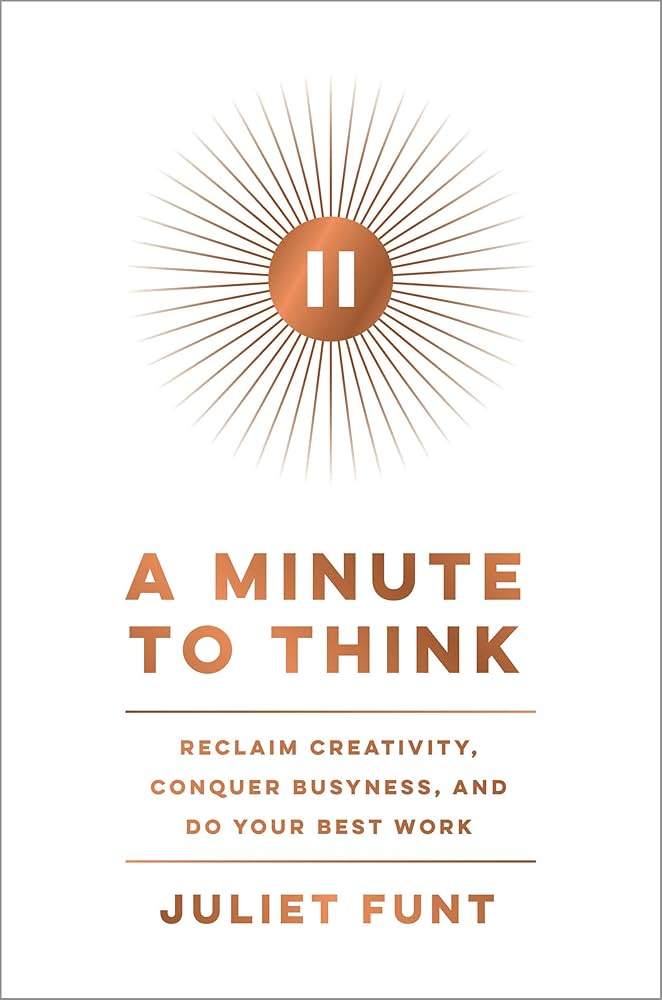
Are you aiming to lead a more productive or creative life? Maybe you’re constantly pouring your energy into your career but still feel it’s not enough. If this resonates with you, you might be overworking and underthinking.
In this book, you’ll discover:
– How your smartphone is damaging your friendships.
– The importance of cutting back on email usage.
– The productivity benefits of daydreaming.
Are you aiming to lead a more productive or creative life? Maybe you’re constantly pouring your energy into your career but still feel it’s not enough. If this resonates with you, you might be overworking and underthinking.
That’s where this book becomes essential. You’ll learn the importance of stepping away from your hectic schedule to rest, reflect, and recharge. Whether it’s dealing with emails, meetings, or personal relationships, you’ll see how creating some breathing room can enhance your work performance. Filled with practical tips, this guide shows you how to accomplish more by doing less.
In this book, you’ll discover:
– How your smartphone is damaging your friendships.
– The importance of cutting back on email usage.
– The productivity benefits of daydreaming.
Everyone and everything requires breathing room. The author came to this realization during a family vacation when she attempted to build a fire. Despite stacking paper, fire starters, and logs, the fire wouldn’t ignite no matter how many matches she used.
Eventually, she realized the issue: she had packed everything so tightly that there was no oxygen for the fire to catch. Simply put, the fire lacked the space to breathe. Similarly, our daily lives can resemble this overpacked fire. By filling our schedules with endless tasks and to-do lists, we prevent ourselves from nurturing our own potential.
The central message here is: We lack the time to simply think. Instead of allowing ourselves moments of reflection, we’re constantly in action. From the moment our morning alarm goes off, our day rushes by in a whirlwind of commuting, emails, meetings, and often family obligations. By the time we finally get into bed, we might question whether we truly accomplished anything that day.
If this situation resonates with you, you’ve uncovered an important but challenging reality: being busy does not equate to being productive. In fact, excessive busyness can actually hinder your productivity. Take Linda, for example, a successful sales professional in the healthcare sector. Although she was thrilled about her promotion, it came with an overwhelming increase in her workload.
To manage her overloaded schedule, Linda eliminated her daily lunch break and kept a jar of peanut butter on her desk to eat while working. She made other sacrifices as well, but despite these efforts, she found herself unable to make progress. Her once exceptional results and meticulous attention to detail, which had earned her the promotion, began to decline. Without the breathing space she had in her previous role, her ability to excel was hampered, and her potential was constrained.
Linda’s experience clearly shows that she was overwhelmed by her busy schedule. However, in our own lives, many of us fail to recognize when we’re overextending ourselves. Instead of finding and appreciating moments of relaxation, we often fall into a contemporary trap: feeling guilty for not being constantly busy.
Economists refer to this as performative busyness. We’ve absorbed the belief that being constantly busy is a sign of success. Instead, we should resist the pressure of overfilled schedules. The upcoming key ideas will explain why this approach is crucial.
Where does our drive for constant activity originate? Surprisingly, the answer may be found in an unexpected source: the American TV show *Candid Camera*. This program films unsuspecting Americans reacting to orchestrated scenarios. In one memorable sketch, a group of actors boards an escalator and then turns to face the wrong direction. Remarkably, the unsuspecting person on the escalator also turns around to match their behavior.
You might wish to leave the office on time to spend time with your family or friends, but then you notice your colleagues settling in for a late night of work. It feels almost unthinkable to be the only one heading out. Or maybe you’re aware that your coworkers are constantly available and quick to reply to emails the moment they arrive. Can you really leave your messages unread in your inbox?
The main point here is that we often overwork ourselves just to fit in.
Our adherence to the culture of constant busyness can be likened to a form of subtle brainwashing, where our workplaces condition us to embrace the flawed logic that being busy equates to being productive.
Take, for example, a senior accountant at a corporate firm. Despite his high status, he finds it nearly impossible to carve out any free time. He ends up spending extended periods in unproductive meetings. This is because he’s among the many employees who have been conditioned to believe that mere presence is crucial and that having downtime is insignificant.
Unfortunately, our tendency to adapt to the constant state of busyness is not benefiting either our well-being or our productivity. A recent Gallup study found that almost a quarter of all workers frequently experience burnout. Similarly, a Deloitte study discovered that more than two-thirds of employees feel their workload is “overwhelming.”
Perhaps the most unfortunate aspect is that this stress and burnout are entirely avoidable. Research conducted by Microsoft in Japan revealed an unexpected finding: a four-day workweek increased productivity by 40% and reduced overhead costs by nearly 25%. This demonstrates that reducing busyness does not necessarily mean sacrificing profitability—in fact, the contrary is often true.
We’ve established that being overly busy negatively impacts productivity. But why does this occur? Scientists have uncovered that it’s linked to how various regions of your brain collaborate. For instance, think about the overwhelming to-do list on your desk. This list embodies a series of challenging and complex tasks. To tackle these tasks, you must activate the frontal lobe of your brain, which is responsible for higher-level thinking.
However, the frontal lobe has limited stamina; it becomes fatigued quickly and requires regular rest to recover. If you persist in working through your to-do list without taking breaks, your frontal lobe’s efficiency will diminish. As a result, your thinking and decision-making capabilities will suffer. Taking a break is essential for maintaining optimal performance.
The main point is that taking breaks can enhance your creativity. To grasp why breaks are so beneficial, we need to look at how creativity functions in the brain. Creativity stems from the brain’s ability to connect current thoughts with past experiences. This process requires periods of uninterrupted, free time for your brain to generate new ideas. Essentially, allowing yourself time to think is key to unlocking your creative potential.
The advantages of taking breaks are evident in real-world scenarios. For instance, a Carnegie Mellon study demonstrated that taking even a brief pause of 30 seconds or just three seconds could significantly enhance workers’ engagement and concentration on their tasks. The key factor is not the duration of the break but how you use it.
Researchers from Harvard Business School have categorized breaks into four common types. The first is the social break, which involves interacting with colleagues. The second is the nutritional break, typically involving a snack or a drink of water. The third type is the relaxation break, which includes activities like daydreaming or light exercise. Lastly, there are cognition breaks, during which you might read a book or browse social media.
The study revealed that only relaxation and social breaks positively impacted productivity, while cognitive breaks actually reduced performance. Therefore, to maximize the benefits of your break, avoid checking social media or reading the news. Instead, consider taking a stroll to chat with a colleague!
What influences your actions at work? For many of us, two main motivators are at play: the desire for excellence and the pursuit of information. While these drives are fundamentally beneficial, they’ve become excessively intense in today’s work environment.
The central idea is: Our fundamental motivations are encroaching on our precious free time. Our pursuit of excellence can quickly shift into perfectionism. Unsure if you’re a perfectionist? Consider these questions: Have others ever remarked that you obsess over details? Do you put excessive effort into tasks that may not be significant?
If you answered “yes” to either of these questions, you might be struggling with perfectionism, a notorious time-waster. You probably invest more time in tasks than others, striving to make your work as flawless as possible.
While this approach might seem commendable, issues arise when you apply it to every task. Time, like excellence, is limited. Imagine you’re distributing golden coins from a small purse—each attempt at achieving perfect excellence costs you a coin. You can decide who gets these coins, but eventually, you’ll run out. Therefore, reserve your efforts for tasks and people who truly warrant them.
Let’s examine our other drive: the thirst for information. This can result in information overload, which also consumes valuable time. Do you feel compelled to click on notifications as soon as they appear? Are you constantly checking your inbox for new messages or sharing data and facts with many others, even if it’s not necessary? If so, you might be overwhelming yourself with information.
We inhabit an era where information is excessively plentiful. For instance, reading a single edition of the New York Times today provides more information than someone in the 1600s would have received in an entire year! Clearly, the volume of information now available far exceeds what our brains have evolved to handle.
To manage information overload, it’s crucial to accept that you’ll never feel completely knowledgeable, regardless of how much you learn. Once you overcome one challenge, another will inevitably arise. And that’s perfectly fine.
Many of us are deeply engaged in digital communication throughout our workdays. Where we once had face-to-face meetings, we now rely primarily on email or, more recently, Zoom. Unfortunately, this shift hasn’t been beneficial for our personal space. Research indicates that these new technologies are draining our attention, negatively impacting both our relationships and our productivity.
Think about how smartphones affect our relationships. Research has demonstrated that just having a smartphone on the table while conversing with someone can make that person feel less positively about you. Smartphones also hinder productivity; studies reveal that keeping your phone nearby diminishes your cognitive performance. In fact, leaving your phone in another room can significantly boost your effectiveness!
The central message here is that our craving for digital communication is negatively impacting both our relationships and our work. While it seems simple to put our devices away for a while, we all know that it’s far from easy. So, why are we so hooked on scrolling through social media or constantly checking our emails?
Much of this can be attributed to how our brains are wired. Similar to a gambling addict who can’t resist inserting another coin into a slot machine, each time we “pull-to-refresh” on our devices, we are met with a stream of new content. This action triggers a release of dopamine, the brain’s pleasure chemical, much like the thrill a gambler experiences when hitting the jackpot.
When we check our emails, we experience more than just the excitement of discovering new messages; we also engage in procrastination. This behavior helps us avoid tackling more challenging or complex tasks. Essentially, frequently checking our emails gives us the illusion of productivity while we’re actually evading the activities that would truly drive our progress.
To break free from your email addiction, consider implementing an “email diet.” This strategy involves checking your emails only during specific times of the day, similar to meal or snack times. For example, you might choose to check your inbox at 9:00 a.m., noon, 3:00 p.m., and 6:00 p.m. Treat your email consumption like food—essential but not excessive.
Language is one of the most potent tools available to us. It allows us to articulate our aspirations and set our objectives. In moments of conflict, the way we choose our words can either mend the gap or widen it further. An important, though frequently overlooked, fact is that we can enhance our communication abilities by taking a moment to reflect before we speak.
One of the most effective ways to apply this principle is to pause and reflect on how you will express your thoughts before speaking. In a professional setting, this means carefully selecting the appropriate method of communication.
The main takeaway is: Select your communication method thoughtfully. Two-dimensional communication, such as emails, text messages, or instant messages, is fast but superficial. It works well for straightforward yes/no questions or situations where you need a quick approval.
Issues occur when you attempt to use two-dimensional mediums for more intricate discussions. This is because such methods, relying on written text, struggle to capture nuance and convey emotion effectively.
That’s where 3D mediums become relevant. 3D encompasses various forms of direct interaction, such as face-to-face meetings, phone calls, or even Zoom calls. Because it supports nonverbal communication—like vocal tone and body language—3D facilitates much more nuanced and engaging conversations.
As we discuss communication, it’s crucial to think about how you engage with your coworkers, particularly when addressing sensitive issues. Before reaching out, try to see the situation from their perspective: consider how they perceive you and what they hope to achieve. When you initiate the conversation, begin by expressing appreciation, as this sets a respectful tone for the discussion.
Next, discuss your experiences, your feelings about them, and your preferences for future outcomes. Communicating in this clear and logical manner will facilitate more productive and rational interactions.
What do meetings signify to you? Many of us previously viewed them as interruptions that consumed our schedules and prevented us from accomplishing meaningful work. However, this perspective shifted with COVID-19. Confronted with the possibility of prolonged separation from our colleagues, we began to yearn for the connection that in-person meetings provide. We miss the closeness that comes from discussing our thoughts and ideas around a table.
The pandemic has highlighted that we shouldn’t seek to eliminate meetings entirely. Doing so would mean missing out on important opportunities for creativity and collaborative problem-solving. Instead, we should reassess how we approach meetings to ensure they occupy the right amount of time in our workdays—neither too little nor too much. This approach will help prevent meetings from encroaching on our personal time.
The main takeaway is that not all meetings are the same. To determine the appropriate amount of time to allocate for a meeting, consider asking yourself two essential questions when you receive a meeting invitation in your email.
First, consider whether you have something unique to contribute to the meeting. Do you have an important idea to share, or could your absence lead to your team missing crucial information and making incorrect decisions? If so, it’s important to accept the invitation.
The second question to consider is whether attending the meeting would be beneficial for you. For instance, if you want to engage with a key senior leader who might assist your career advancement, or if you need to discuss matters with colleagues to progress on a project, then attending the meeting would be worthwhile. However, if you answer “no” to both questions, there’s no need to feel guilty about declining the invitation.
If you decline a meeting invitation, you can still stay engaged by arranging for a team member to attend on your behalf. This approach ensures you stay informed about any important updates and provides a valuable opportunity for a subordinate who might not have had the chance to participate in such meetings before.
The main takeaway from this book is this: While others may pride themselves on being constantly busy, you don’t have to follow suit. Genuine success isn’t about filling your schedule with endless tasks and meetings; it’s about being creative, productive, and focusing your time on what truly matters. And if you pause to reflect, you’ll likely find that you already know what those important things are.
Practical advice:
Reevaluate your sense of urgency.
In today’s fast-paced work environment, it often seems like everything is urgent. The author refers to this as “hallucinated urgency.” When you treat every decision, request, or email as if it’s critical, you may fall into the trap of reacting without proper consideration. So, the next time you feel the need to immediately respond to something in your inbox, take a moment. Ask yourself, Do I really need to handle this right now, or can I allow myself some time to think it through?