In these key points, you’ll uncover:
– why reading is much more than just an escape,
– how love resembles a telephone, and
– Marcel Proust’s ultimate advice for building friendships.
If the name Marcel Proust doesn’t ring a bell, consider this book your ideal introduction to the celebrated French author. If you’ve been meaning to dive into his works, this might just provide the nudge you need. And if reading Proust isn’t on your radar at all, you can still savor the charming and insightful life lessons drawn from his iconic 1913 masterpiece, *In Search of Lost Time.
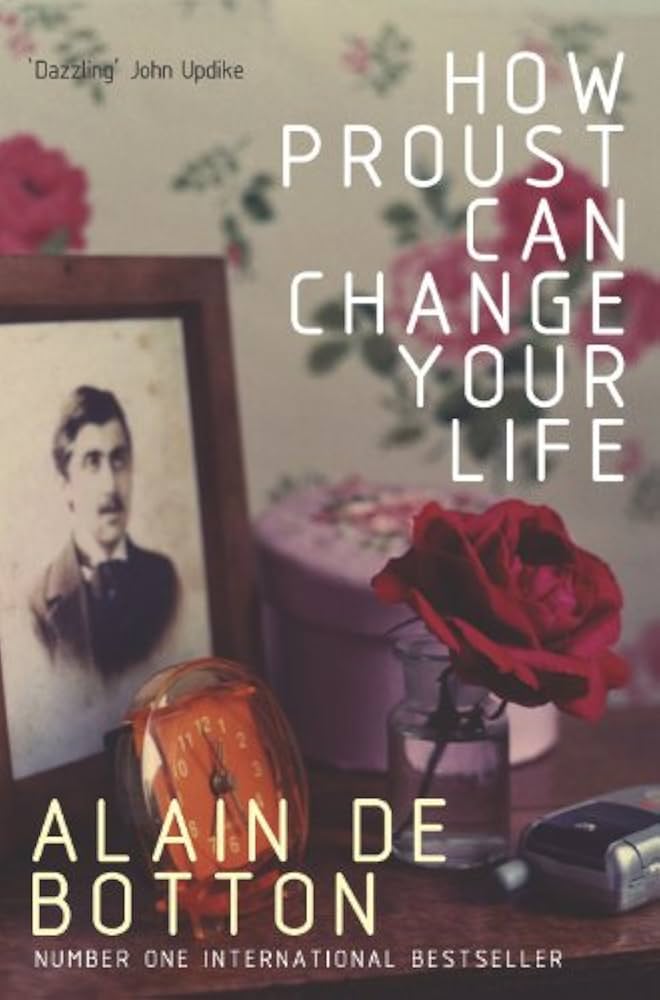
Leading us through this exploration is Alain de Botton’s 1997 work, How Proust Can Change Your Life. This unique book combines elements of literary self-help with a biography of Proust, demonstrating how the French author’s wisdom provides timeless solutions to virtually any challenge you might face.
The core takeaway from this journey is simple: read Proust. As you’ll soon discover, he’s far more than just a literary genius—his insights have the power to transform your life.
In these key points, you’ll uncover:
– why reading is much more than just an escape,
– how love resembles a telephone, and
– Marcel Proust’s ultimate advice for building friendships.
Marcel Proust’s monumental seven-volume work, In Search of Lost Time, chronicles its narrator, also named Marcel, as he reflects on his life—from childhood to the brink of death—within the aristocratic society of nineteenth-century France. Widely celebrated as a masterpiece by critics and readers alike, the novel achieved acclaim. However, the critic whose opinion mattered most to Proust, his father, Dr. Adrien Proust, passed away four years before the first volume’s publication in 1913.
Adrien Proust, a physician and medical professor, was a prolific author in his own right, producing 34 works focused on specialized topics like disease transmission. However, his son Marcel often feared he was a disappointment to his father. Marcel struggled to pursue a “respectable” career, abandoning one path after another. He lasted less than two weeks in a solicitor’s office, dismissed the idea of a diplomatic career because he couldn’t bear to leave Paris, and resigned from a library position because of the dusty books. In truth, all Marcel truly wanted to do—much to Adrien’s dismay—was devote himself to writing.
Marcel Proust believed that literature held its own unique importance, rivaling even that of medicine. To him, reading fiction possessed a therapeutic quality. His father, Dr. Proust, would have likely scoffed at such an idea. After all, while a novel might provide distraction on a lengthy train ride, it couldn’t diagnose tuberculosis or carry out an appendectomy. Yet, Dr. Proust’s skepticism couldn’t have been further from the truth.
According to Alain de Botton, one of the therapeutic benefits of reading Proust is that it fosters a sense of connection with works of art. Proust didn’t merely appreciate the technical aspects of paintings, such as their composition or color; he often linked the figures in the artwork to people he knew. For instance, while studying a Renaissance portrait of an elderly man by Ghirlandaio, painted in 1480, Proust noted its resemblance to a contemporary aristocrat, the Marquis de Lau. Whether exploring a modern novel or contemplating centuries-old art, Proust felt a deep familiarity with these creations because he recognized how they mirrored aspects of his own life.
Diving into Proust’s work can encourage you to develop a similar perspective. In Search of Lost Time introduces readers to a vivid array of characters, from aristocrats and artists to socialites, workers, and peasants of Belle Époque France. At first, their lives may feel distant, their preoccupations seemingly unrelated to your own. But as you continue reading, you’ll begin to uncover connections between their experiences and yours. With time and persistence, this ability to find parallels will extend to other forms of art as well. A vast cultural landscape, spanning everything from Homer’s ancient epics to the latest in contemporary performance art, will become more accessible and meaningful.
Reading Proust can help alleviate feelings of loneliness. Just as deeply engaging with In Search of Lost Time allows you to discover similarities between your life and Proust’s, it also helps you find comfort in the shared experiences of his characters. Each day, we experience a wide range of emotions, from the most joyful to the most painful. But how often do we truly share these feelings with the people around us? How well do we understand the emotions and thoughts of others? If you’re holding onto resentment from a past argument or suddenly feeling acutely aware of your own mortality, do you openly share these emotions with coworkers, neighbors, or even your dentist? Probably not. This can lead to a sense of isolation, making you feel as though you’re the only person who has ever felt or acted this way. The beauty of Proust’s novel is that it provides a window into the deepest, most private thoughts and feelings of a wide array of characters. In Search of Lost Time masterfully brings this to life. If you’ve ever felt alone in your emotions, within Proust’s pages, you’re bound to encounter a character who has felt exactly the same.
Ultimately, reading Proust will help you gain a deeper understanding of yourself. Proust captured this insight most succinctly when he said, “In reality, every reader is, when he is reading, reading his own self.” To truly discover yourself, begin with the first volume of Proust and encounter Marcel through its pages.
There’s a reason why many avoid reading Proust, even those who eagerly dive into other classic novels like Great Expectations or Anna Karenina. For one, it’s incredibly long. The Penguin Clothbound Classics edition spans a hefty 3,444 pages, and those pages are far from filled with quick, concise sentences. In fact, in volume 5, there’s a sentence so lengthy it could circle the base of a wine bottle 17 times. In Search of Lost Time even inspired a Monty Python sketch titled “All-England Summarize Proust Competition,” where each contestant is given 15 seconds to summarize all seven volumes—an obviously absurd task.
Here’s the paradox: the very reason most people avoid reading Proust is exactly why you should consider reading it. You should read *In Search of Lost Time* precisely because it’s incredibly, exceptionally long.
In today’s world, we prioritize speed and efficiency over thoughtful reflection. We speed up podcasts to 1.5x, rush to reply to emails almost immediately, and consume news in bite-sized tweets of 280 characters. Instead of truly reading books, we settle for just the key points. We know, at least in theory, that we should slow down sometimes—but slowing down is much easier said than done.
Proust compels readers to slow down. It’s nearly impossible to speed through a sentence that could circle a wine bottle 17 times. By embracing length, Proust allows room for nuance, complexity, contradictions, and deeper exploration. He was famously frustrated by the brief summaries in the news, where stories were reduced to a couple of lines—like “disgruntled wife murders husband” or “factory worker electrocuted on the job.” These terse accounts never provided enough depth for him. They stripped real people of their complexity, reduced them to clichés, and, most importantly, in Proust’s view, discouraged the reader from feeling empathy.
In Search of Lost Time serves as a response to the shallow news stories that troubled Proust: every character, no matter how minor, is depicted with depth and complexity. Experiencing Proust’s profound empathy for his characters teaches us how to develop our own ability to empathize.
Another reason for the novel’s length is that Proust strives to capture life with a sense of newness, avoiding tired or clichéd descriptions.
While Proust was writing In Search of Lost Time, a group of artists called the Impressionists was shaking up the French art scene. Today, we regard the patchy paintings of lakes, harbors, and sunrises by artists like Claude Monet as masterpieces. However, at the time, they were widely criticized for lacking realism. Critics argued that the smudged blues and pinks of oil paint failed to truly capture the essence of a lily pond.
Proust understood exactly what the Impressionists were aiming for, which is why one of his most relatable characters, Elstir, is a fictional Impressionist painter. The Impressionists weren’t concerned with creating a hyper-realistic image of a lily pond. Rather, their goal was to capture a personal perspective of the pond—an interpretation of how it was seen, rather than a precise rendering. Proust’s literary approach mirrored this: he wanted to avoid clichés and superficial descriptions. He didn’t want to rush through phrases like “the silvery moon” just to move the plot forward. Instead, he portrayed the moon like this:
“Sometimes in the afternoon sky, a white moon would rise like a small cloud, discreet and unassuming, resembling an actress who doesn’t need to perform for a while and, so, watches the rest of the cast from the background, dressed casually, not seeking attention.”
Similar to the Impressionists, Proust encourages us to view everyday things, like the moon in the late afternoon, from a fresh perspective. If conveying that new way of seeing required a few more words, Proust was more than willing to take the time.
In In Search of Lost Time, the narrator spends much of his time wandering through the countryside, attending social events, and struggling with sleeplessness. The novel famously begins with a 17-page exploration of his battle with insomnia. Over the course of this extensive work, the narrator never experiences lasting love. The relationships portrayed in the novel are far from idealized; for example, the marriage between the emotionally distant Charles Swann and his unfaithful wife Odette is thoroughly dissected. As for Proust himself, though much of his personal romantic life remains unknown, his experiences as a gay man in a society that viewed homosexuality with disapproval undoubtedly influenced his perspective on love and relationships.
Does this mean Proust offers no insights into love? Not necessarily. While he may not address love directly, he has much to say on the subject in more subtle ways, starting with the narrator’s early encounter with Gilberte. As a young boy, Marcel sees Gilberte playing in the Champs Élysées and is immediately captivated. He imagines in great detail the joy of becoming her friend and sharing tea at her home. Eventually, his dreams come true, and Gilberte invites him to afternoon tea. Marcel is initially spellbound, but as she pours tea and serves cake, he begins to realize that while Gilberte is indeed charming, the version of her he had imagined in his mind was even more enchanting.
What’s the takeaway from this? In real life, people rarely match our idealized perceptions of them. Additionally, it’s challenging to fully appreciate or love someone with unwavering intensity over a long period. Similarly, expecting our romantic partners to constantly and passionately admire us is unrealistic.
Proust suggests that familiarity can diminish even the strongest of passions. This concept is a recurring theme in both his life and work. For instance, when writing about the invention of the telephone, Proust notes how quickly something once seen as extraordinary can become an ordinary part of daily life. Alexander Graham Bell created the telephone in 1876, and by 1907, Proust remarked that it had transformed from a miraculous invention to something we use without much thought—just to call a tailor or order ice cream.
In Proust’s view, everything—whether it’s love or telephones—loses its enchantment over time and with familiarity. Does that mean lasting love is impossible? Not necessarily.
Proust suffered from poor health, a condition that was far worse than just being mildly unwell. His ailments ranged from asthma and digestive issues to a deep fear of mice, often leaving him confined to his bed. During one of these episodes, he began reflecting on the biblical story of Noah. Isolated on his ark, Proust thought he might feel similarly removed from the world. Initially, he felt pity for Noah, stranded far from land. But soon, he realized that Noah, surrounded by water, likely valued land more deeply than anyone could. In his isolation, Noah would likely have such a vivid, longing image of his homeland that, in a way, he might actually “see” it more clearly on the ark than he ever did on solid ground. Proust imagined that no one could love their home more than Noah.
Through the story of Noah, Proust suggests that even things that become dull from familiarity regain their value when we’re separated from them. While it’s unrealistic to follow Noah’s example and distance yourself from your partner for forty days and nights, you can create your own version of an “ark.” For Proust, a brief illness only heightened his desire to reconnect with friends. Similarly, taking a short break from your partner—whether it’s a night apart or a day without contact—can provide the opportunity to rediscover the charm and appreciation you have for them.
In an unpublished essay, Proust portrays a young man sitting gloomily in his parents’ Paris apartment. The lunch remnants are still on the table, his mother is knitting in a corner, and a cat rests on top of a cupboard. The young man is downcast because, as an aesthete, he longs for great art, fine cuisine, and beautiful landscapes. However, he lacks the means to afford these luxuries. How can he find a way to overcome this sense of discontent?
Proust recommends a trip to the Louvre, but not to immerse oneself in the exotic scenes of Venetian canals or Greek temples. Instead, he advises the young man to explore the works of French painter Jean-Baptiste Chardin. Chardin’s focus was on the ordinary, capturing everyday life rather than grandiosity. He painted scenes of workers, housewives, and middle-class families, as well as still lifes featuring simple objects like bread, fruit, fish, coffee pots, and salt cellars.
Why, when the young man yearned for a world beyond his grasp, would Proust encourage him to focus on such mundane scenes? Because Chardin captured the very world the young man inhabited, but he made it appear remarkable. While art can showcase extraordinary events, Proust believed its true purpose was to reveal the magic within the everyday. By enchanting the ordinary, art encourages us to look more closely at our own lives and recognize the beauty around us. Proust concludes the essay by telling the young man: “When you walk through a kitchen, you’ll see it as interesting, grand, and beautiful, just like a Chardin.”
Another melancholic young man appears in In Search of Lost Time: the narrator, Marcel. Like the young man in the essay, Marcel is dissatisfied with the dullness of his bourgeois life. However, everything shifts when his mother brings him a tray with afternoon tea, which includes a now-famous pastry. This simple treat, a sponge cake shaped like a seashell, is a madeleine. When Marcel bites into it, his life changes.
Not because the taste itself is extraordinary — at the time, Parisian patisseries offered more elaborate and indulgent desserts than the modest madeleine. Rather, it is because the taste brings him back to his childhood, recalling the madeleines his Aunt Leonie would give him during his visits to Combray. In that instant, Marcel is transported to the sights, sounds, and emotions of his youth. This moment triggers a flood of memories, leading to thousands of pages of reflection and reminiscence.
The madeleine does more than just remind Marcel of his childhood; it has a deeper, more transformative effect. Just moments before, as Marcel reflected on his life, it had seemed monotonous and lackluster. However, after tasting the madeleine, he suddenly views his childhood as a much more idyllic and meaningful time than he had remembered. The madeleine has reawakened a sense of wonder in Marcel, turning his previous, dull recollections into something magical.
But what if you want to bring that sense of enchantment back into your own life? Should you wait for your own version of the madeleine to appear? You could — but it might take a long time.
At one point in the book, a teenage Marcel visits a coastal resort, filled with excitement and high expectations. He envisions a dramatic and romantic scene: rugged cliffs, a dark ocean, and ominous clouds. However, upon arrival, he is disappointed to find the town is much more ordinary than he had imagined. The contrast between his idealized vision and the actual town threatens to spoil his trip. Fortunately, Marcel encounters Elstir, the fictional Impressionist painter. Elstir invites him to his studio, where Marcel is captivated by the artist’s portrayals of fishing boats veiled in morning mist and village women perched like mermaids on coastal rocks. Elstir has discovered the beauty in these everyday scenes, and through his perspective, Marcel begins to see it as well.
Proust understands that everyday life can hold a certain magic; a simple madeleine can be as delightful as a gourmet meal at a top Parisian restaurant. However, he doesn’t expect you to suddenly wake up one day and see beauty everywhere, nor does he believe you will be handed your own “madeleine” that will instantly transform your perception of life. What he does believe is that you can cultivate this appreciation by studying the works of artists who have dedicated their lives to revealing the extraordinary in the ordinary—artists like Chardin, Elstir, and, of course, Proust himself.
If you’re eager for more of Proust’s wisdom, you’re in luck—he was generous with his thoughts and insights. Here are a few more of his suggestions for living.
Insomnia, unfortunately, is something many of us experience. However, Proust suggests it does have its benefits: “A bit of insomnia can have its value by helping us truly appreciate sleep, shedding light on that darkness.”
Proust also believed that, with a touch of imagination, anything can become engaging reading material. In his early twenties, he had yet to read authors like Dostoevsky or Dickens—a gap he later filled—but he was known to find the French regional train timetable just as captivating as any novel, enjoying its depiction of provincial French life.
Intellectual elitism should be avoided. Moreover, just because you and someone else share a favorite Tolstoy novel doesn’t necessarily mean they’re the ideal person for a deep friendship. In fact, when Proust met James Joyce, they struggled to find much common ground. When asked if he saw his friends as intellectual equals, Proust responded, “I do my intellectual work within myself, and once I’m with others, it matters little to me whether they’re intellectuals, as long as they are kind.”
When it comes to romance, playing hard to get is a reliable tactic. Proust observed, “There’s no doubt that a person’s charms are less often the reason for love than a statement like, ‘No, I won’t be free this evening.’”
There’s a simple trick to getting the most out of any dinner party you host. Proust was known for circulating around the table with each course, enjoying his soup while chatting with one guest and finishing his fish while talking to another. As one friend recalled, “By the time he reached the fruit, he must have made his way all around.”
Doctors, and the medical field in general, may be inconvenient but are a necessary part of life. Proust remarked, “To completely dismiss medicine would be foolish, but to ignore it entirely would be an even greater folly.”
Want to make friends and leave a lasting impression? Follow Proust’s example and ask more questions than you answer. Those who knew him recall how he would engage his conversation partners on a wide range of topics, even discussing the proper care of motor cars. According to one friend, he was an exceptional listener.
And when nothing else works, there are always books. As Proust put it, “In reading, friendship returns to its purest form. There’s no pretense with books. If we spend an evening with them, it’s because we truly desire to.”
The central message of this book is that *In Search of Lost Time* is much more than a literary classic. It’s a rich repository of characters that deepen your empathy, language that transforms your perception of the world, and timeless ideas that resonate as strongly today as they did when first written. Immersing yourself in Proust’s work and engaging with his insights has the power to fundamentally reshape how you think, see, and experience life.
Here’s a practical takeaway: let reading inspire action.
Proust believed that the ultimate purpose of reading is to spark engagement with life. If that means putting a book down for a while, so be it. Has *In Search of Lost Time* motivated you to embark on something new or revisit an old passion? Don’t wait until you’ve reached the last page—start now. Follow the example of Virginia Woolf, who famously paused her reading of Proust’s masterpiece to create one of her own: Mrs. Dalloway.