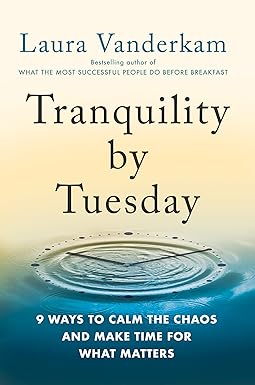
Exciting news is on the horizon! Achieving a balance is entirely possible: a fulfilling career, a joyful family life, and a revitalizing personal life can all be yours simultaneously. The key lies in strategic time management.
In her hands-on guide to finding peace in your daily life, Laura Vanderkam introduces nine straightforward but profoundly impactful strategies to carve out moments for yourself while boosting your productivity. Achieving more in less time may seem like a sleight of hand, but it essentially boils down to effective scheduling.
“Tranquility by Tuesday” offers a succinct summary of Vanderkam’s strategies. It presents insights valuable to everyone, from CEOs to those currently seeking employment, aiming to find peace amidst turmoil.
Exciting news is on the horizon! Achieving a balance is entirely possible: a fulfilling career, a joyful family life, and a revitalizing personal life can all be yours simultaneously. The key lies in strategic time management.
In her hands-on guide to finding peace in your daily life, Laura Vanderkam introduces nine straightforward but profoundly impactful strategies to carve out moments for yourself while boosting your productivity. Achieving more in less time may seem like a sleight of hand, but it essentially boils down to effective scheduling.
By dividing your life into weekly segments and deliberately setting aside extra time, you’ll find the space to engage with your hobbies and interests, leading to more efficient, not just harder, work. Engaging in these methods does more than just improve your organization; it guides you towards a more fulfilling life by emphasizing the importance of self-care, your aspirations, and your overall health.
“Tranquility by Tuesday” offers a succinct summary of Vanderkam’s strategies. It presents insights valuable to everyone, from CEOs to those currently seeking employment, aiming to find peace amidst turmoil.
“I’m completely worn out.” “Putting my kids to bed consumes so much of my evening, I hardly have time to unwind.” “I spend all my time on household tasks, yet it seems like I never make any progress.”
Does this resonate with you?
When you’re caught up in the routine of everyday life, it might seem hard to perceive yourself as genuinely achieving success. Success is frequently measured by its external indicators: a stylish home in a prestigious area, having a child in a prestigious university, possessing a high-status job. However, instead of chasing success through these conventional milestones, what if you began to find value and accomplishment in the simple, everyday moments?
Success doesn’t need to be defined by concrete outcomes; it can be found in the quality of your daily life. How do you ensure your days are rich and fulfilling? Through purposeful action. There are nine distinct strategies to lead a life that is more serene, efficient, and conscious. By organizing your time on a weekly basis and thoughtfully planning your schedule, you can attain both accomplishments and a sense of peace.
Time management is a skill that blends creativity and technique. We’re about to introduce nine techniques for mastering this discipline. The initial tactic, while common among parents, might not be one you regularly apply to yourself. This simple yet effective strategy is establishing a bedtime.
The average adult requires seven to nine hours of sleep. Despite many claiming to sleep within this range, a prevalent issue is waking up feeling exhausted and sluggish. This indicates that the duration of sleep doesn’t always align with its quality.
Rather than sticking to a 10:00 p.m. bedtime, perhaps you unintentionally fell asleep with your toddler at 8:00 p.m., woke up at 9:00 p.m., took care of kitchen tasks, and ended up watching a movie until you nodded off on the sofa at 11:30 p.m. Even if this totals eight hours of sleep, it’s not as rejuvenating as consistently sleeping from 10:30 p.m. to 6:30 a.m.
For improved sleep quality, try this straightforward approach. Calculate your bedtime by counting back seven to nine hours from when you wish to wake up. Then, set an alarm to go off 15 minutes prior to your determined bedtime to start your wind-down routine. Though this method might appear basic, its impact on your sleep and overall well-being can be significant.
Enhance your time management by implementing the second step: schedule the upcoming week, from Monday through Sunday, on Fridays.
Why choose Friday? It’s primarily because late Friday afternoons are typically when people begin transitioning into weekend mode, finding themselves less inclined to tackle demanding tasks. This makes it an ideal time for planning activities.
Organizing your next week and weekend in advance offers additional benefits: your immediate weekend plans are set, giving you events to anticipate. Moreover, since this time is already scheduled, you can fully enjoy the weekend without needing to allocate time for planning on Sunday, thereby preserving your weekend evening.
Scheduling your activities well in advance increases the chances of engaging in meaningful and satisfying experiences, rather than opting for spontaneous, last-minute decisions. This might mean booking a dinner at a new restaurant that needs reservations ahead of time, instead of resorting to the familiar spot you’ve visited repeatedly.
Moving on to the third step, ensure that by 3:00 p.m., you’ve engaged in some form of physical activity, be it a brief stroll or a quick 10-minute session on your treadmill. This simple action can provide a sense of accomplishment, help you overcome the afternoon drowsiness, and significantly enhance both your health and mental state.
Exercise is a goal many of us strive for, yet it’s common for daily responsibilities to hinder our plans. Here’s a comforting piece of advice and the fourth rule: establishing a habit doesn’t require daily commitment. Engaging in an activity just three times a week can significantly impact your routine.
Here’s the encouraging part: when you examine your routine, you’ll likely notice that you’re already partially practicing your desired habit a couple of times a week.
Consider the highly praised concept of family meals, for instance. You might feel guilty for not organizing the perfect family dinner nightly. However, chances are you’re managing to have dinner together at least on some weekdays, like Tuesdays or Wednesdays. Plus, if you have a tradition of pizza and a movie on Fridays and pancake breakfasts on Sundays, then congratulations! You’re already having three shared meals a week.
The most rewarding aspect? By identifying and valuing the activity you wish to dedicate time to – be it working out, engaging in a hobby, or focusing on spiritual growth – you’ll naturally find yourself participating in it more frequently. Since you’ve established a realistic target of committing to this interest only three times a week, the pressure and guilt of not engaging in it every day will dissipate.
In “Scarcity,” Sendhil Mullainathan and Eldar Shafir discuss a Missouri acute-care hospital that achieved a 100 percent occupancy rate for its operating theaters. Despite this achievement, the high booking rate led to operational challenges. Emergencies required immediate attention, necessitating the rearrangement of planned surgeries. This resulted in inconvenient postponements and a ripple effect of scheduling conflicts.
A consultant proposed a seemingly paradoxical strategy: reserve an operating room exclusively for emergencies. The idea initially met with skepticism; with an already high demand, how could dedicating an operating room solely to emergencies be beneficial?
Surprisingly, this minor adjustment had a significant impact. By directing all emergency surgeries to this designated room, the hospital not only minimized delays but also increased its capacity to perform more surgeries in total.
Our fifth principle mirrors this logic, focusing on incorporating flexibility into your agenda through the allocation of “reserve” time slots. Deliberately integrate buffer periods into your weekly schedule to accommodate unexpected tasks or to adjust for events that were rescheduled due to unforeseen developments.
Imagine you’ve planned to attend a Pilates class on Tuesday evening. However, that afternoon, your partner falls sick. You try to arrange a babysitter for your toddler during your class time, but find she’s unavailable. Consequently, you’re forced to skip your Pilates session. But, by applying the fifth strategy and reserving Friday mornings from 10:00 a.m. to noon as a reserve period, you’d have the flexibility to reschedule your Pilates class to this alternate time slot.
Consider this situation: A family member reaches out, requesting your help to craft a speech for an upcoming graduation celebration next weekend. This might initially send you into a frenzy – creating a speech demands time, and your schedule is already bursting at the seams. However, if you’ve wisely allocated a spare two-hour block in your week, you can accommodate such unexpected tasks without disrupting your planned commitments.
Being aware that you’ve reserved this cushion in your schedule will naturally lead to a more relaxed and efficient mindset. Consider the time you’ve set aside, such as your Friday mornings, as akin to that exclusive operating room. This foresight will ease your worries about completing tasks, ultimately unlocking more opportunities to enjoy life fully!
Looking to extend your lifespan? The key is straightforward: create fresh memories. As youngsters, we’re constantly experiencing novelties—transitioning between schools, heading to college, encountering new faces, and acquiring new knowledge. Our brains perceive these memories as measures of time, meaning a wealth of memories can make time feel elongated. Ever mentioned to your friends how quickly time appears to pass? It could be due to your brain lacking new memorable experiences to latch onto.
Caught up in the demands of work, family, and additional obligations, how can you still forge new memories? The solution is found in the sixth rule: each week, incorporate one significant and one minor adventure into your agenda.
This doesn’t entail dedicating time to embark on an arduous trek or indulge in a lavish escapade. Grand adventures could be as simple as discovering a previously unvisited area in your town or sampling a novel dish. Minor adventures might involve observing fireflies in your backyard or changing the picture in a desk frame. The significance lies not in the activity per se but in the deliberate planning and allocation of time for these experiences. This approach fosters an anticipatory state of enthusiasm, making the sense of adventure stem more from the anticipation than the actual activity.
The essence of success is rooted in scheduling and self-commitment, which brings us to our seventh guideline: dedicating one evening each week exclusively to your own interests.
For many parents, the notion of taking an entire evening off just for personal enjoyment—whether it’s to socialize with friends, attend a book club, meet up for a regular tennis game, or participate in community theater—seems almost unthinkable. Yet, if it were your child engaging in a beloved activity, you wouldn’t hesitate to support them. So, why not afford the same consideration and kindness to yourself by setting aside that time?
Prioritizing your personal time is crucial, and it should be firmly scheduled, independent of others’ availability. If you’ve committed to an activity by enrolling or investing in it, you’re more inclined to follow through. Allocating an entire evening for yourself may seem extravagant, but such moments of self-care offer invaluable and enduring advantages.
When you allocate space in your life for personal development and hobbies, you’ll find that time seems to expand beautifully to encompass these activities. This might even inspire you to dedicate entire days to yourself, whether it’s hanging out at a friend’s place, reflecting in a library or café, or indulging in a short getaway.
Picture yourself deep into a significant task when suddenly, a notification pops up urging you to book a dentist appointment. That distraction leads you to observe the dust accumulating under your desk, which then reminds you to arrange for a cleaning service.
If you end up making those calls to your dentist and cleaner, and even take a moment to sweep under your desk, you’ve not only squandered a significant portion of time but have also interrupted your focus and train of thought.
We’ve previously covered strategies for organizing your daily and weekly activities through planned scheduling and allocating designated times for various tasks. Now, we will explore how to avoid squandering time with our eighth rule: dedicate a specific period to address all the minor, accumulating tasks.
Grouping minor tasks together allows you to focus better on your current activity, understanding that other tasks can be postponed. This approach requires you to distinguish between genuinely brief tasks and those that may appear minor but lead to more extensive, time-consuming efforts. For instance, replying to an event invitation might tempt you to declutter your inbox, which could then sidetrack you into browsing an online sale triggered by a promotional email. Hence, it’s crucial to judiciously evaluate the true scope of each task.
Our ninth and final guideline is to prioritize “effortful” leisure pursuits before allowing yourself to completely unwind with more “effortless” activities. Essentially, make thoughtful choices about how you spend your downtime. Instead of defaulting to aimless browsing on social media, opt for engaging activities like reading, solving puzzles, doing crosswords, or undertaking a small creative project. If you’re concerned these might encroach on your chill-out time, consider setting a timer. This way, you can ensure you’ll still have a moment for more passive enjoyment, like watching a reality TV show. By choosing more engaging leisure activities, you’ll likely find your mood and energy levels improve.
All the time-management strategies mentioned share a core principle: putting yourself first. By strategically organizing your week, you’re safeguarding your time, not just occupying it. This approach yields countless valuable hours, enhancing not only your productivity but also your happiness and fulfillment.
Here’s a practical tip to end on: Establishing a consistent bedtime and adhering to it will ensure you wake up rejuvenated and early, giving you extra time in the morning. Use this opportunity to develop a brief morning ritual. Pick activities – such as writing in a journal, enjoying your coffee outdoors, or tending to your plants – that set a positive tone for the rest of your day.