When was the last time you discussed inflationary cosmology with your neighbour? How often do you talk to your lover about superstring theory? What? Never?
In other words, if Sean Carroll had his way, we’d all be discussing physics and giving our thoughts on the most recent ideas in the same manner that we speak about politics or the economics.
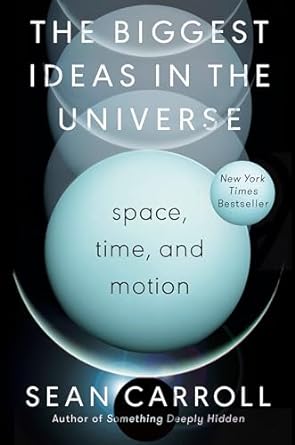
Carroll believes that his book series The Greatest Concepts in the Universe would enable people really understand about current physics – even if they desire nothing more than to remain amateur physicists. Yet, it is unlikely to ever happen. Space, Time, and Motion, the first of the three volumes, focuses on nine themes and examines each one by dissecting the theory and examining equations.
When was the last time you discussed inflationary cosmology with your neighbour? How often do you talk to your lover about superstring theory? What? Never?
In other words, if Sean Carroll had his way, we’d all be discussing physics and giving our thoughts on the most recent ideas in the same manner that we speak about politics or the economics.
Carroll believes that his book series The Greatest Concepts in the Universe would enable people really understand about current physics – even if they desire nothing more than to remain amateur physicists. Yet, it is unlikely to ever happen. Space, Time, and Motion, the first of the three volumes, focuses on nine themes and examines each one by dissecting the theory and examining equations.
Maybe a decent place to start would be with Einstein’s equation.
E=mc2 is presumably what’s in your mind. Energy is equal to mass times the square of the speed of light. It may seem significant, but it’s really nothing.
Professional physicists refer to Einstein’s equation as the general relativity equation’s field equation.
or
Rµv – ½Rgµv = 8πGTµv
Be at ease, however! We won’t explain any further complicated equations in this book, what they imply, or how to solve them; that degree of detail belongs only in Carroll’s domain. Instead, we’ll give you a taste of three of the universe’s most important concepts—space, time, and spacetime—in the hopes that it may fire your appetite to pursue a career in physics, whether it be as a hobbyist or otherwise.
You probably understand what space is. The “thing” is the location of all activity. where the “things” are. But have you ever given space its due consideration? Turning the clock back around 300 years could assist to begin explaining the idea.
There were two schools of thought in the early 1700s. One theory proposed that space was a substance with its own existence and served as the “container” for all other things. The other believed that nothing existed in space. There was substantial debate at the time, notably in a correspondence between Isaac Newton’s rival, German Gottfried Wilhelm Leibniz, and Samuel Clarke in England, who agreed that space was certainly a substance. The discussion abruptly came to a stop in 1716 when Leibniz passed away, although by that time they had covered a wide range of topics, including God, free will, and space.
Today’s majority of physicists agree with Newton that space is in fact a “thing.” What makes them think that? First of all, empty space isn’t real. There are other types of fields functioning inside it, such as gravity. Second, space (as a component of spacetime) is capable of changing.
The entire picture is still not grasped at this time. Yet we do understand certain fundamentals. Consider the dimensionality of space. Choose a few pencils, and then bind them at right angles. After that, grab a third and knot it at the same point as the previous two, so it forms a right angle. Pick up a fourth now, and knot it at the same junction as the previous three, but at a right angle. That is correct! That isn’t feasible. You’ve just successfully shown how three dimensions exist in space.
A stream of electrons flowing quickly down a long wire, for example, is often treated by physicists as having just one dimension. Or having two—a thin layer or an object’s surface—in three dimensions. Nonetheless, despite the fact that they can simulate systems as though they only had one or two dimensions, they really have all three. Also, physicists think beyond three dimensions when discussing string theory or other concepts. It’s not quite as easy as it initially seems, is it? You’ll be glad to hear that this essential principle doesn’t cover all of it.
But, the existence of three-dimensional space gives us a simple justification for why the gravitational force between two objects is inversely proportional to the square of their distance. Think of gravitational force lines as extending outward from the core of the sun. Consider a larger sphere with the sun in the middle. This sphere is the point through which all lines emanating from the sun pass. Lastly, visualise a larger sphere that is farther away. Moreover, all lines cross this megasphere’s radius. Yet, owing to its size, fewer lines than in the first pass through any given location. A sphere’s surface area is directly related to its radius squared. The gravitational force is inversely proportional to the square of the distance between two objects, it follows.
I’ll stop talking about space now. Let’s focus on the next fundamental concept in the cosmos, time.
Think about these two queries for a second. First, “Can we meet at nine o’clock?” Do you want to see this 120-minute movie, second? Both make use of the idea of time, and we are quite aware of what the questioner means in terms of time.
So, let’s take that a step further and consider time in terms of the cosmos. Thus, time may be seen of as a useful means to name the minute changes that occur from moment to moment. During time, something “happens” and undergoes a transition. There couldn’t be a change without time. There is no change from moment to moment. The same.
Time also aids in our future self-location; for example, meeting at 9:00 p.m. is our when. Space enables us to be specific about our where—the café next to our place of employment. The data isn’t really useful if we don’t indicate one or the other. The idea of spacetime, which will be discussed in the section after this, results from combining time and space. But first, let’s talk about a few other time-related characteristics.
Time can be measured, just as space. A clock is used to measure time, right? We need a tool that changes consistently and in a fashion that can be compared to other clocks if we’re going to accomplish this correctly. Fortunately, there are many of “clocks” in the cosmos, or systems that move consistently and predictably in relation to one another. A typical illustration is how Earth spins around the sun; in a year, it turns on its axis little over 366 times.
Yet time and space vary greatly from one another. We move through time whether we choose to or not. We don’t always move in space; consider the COVID-19 lockdowns. yet, time keeps moving even when we stop. Each instant depends on the preceding one as time moves ahead from the past to the present. When we see time from the present, we perceive the past as having ended and the future as still being in the future. Since the history has been documented, we can only forecast the future. The arrow of time is a common name for this direction of time.
Let’s contrast space and time once again. You may recall from the last part that there are two ways to think about space: either it is a substance in and of itself, or it is a useful method to describe where things are in relation to one another. Nonetheless, nobody questioned the reality of any particular places in space. That isn’t the situation when it comes to time.
The idea of presentism, which holds that only the current instant in time is genuinely real, comes first. They are not genuine since the past has passed and the future has not yet arrived.
On the other hand, eternalism contends that every instant of time has equal reality. This perspective on the cosmos is also known as the “block universe view” because it sees the physical universe as a four-dimensional block of spacetime.
A third perspective is possibilism, sometimes known as the expanding present view. According to this perspective, the past and present are both real, but the future is not.
The fact is that there are solid justifications for all three strategies, and they each have advantages.
Greek philosopher Heraclitus espoused presentism as early as the sixth century BCE. He saw that you could never enter the same river again since, at that point in time, it had already changed into a new river. The Greek philosopher Parmenides, who lived a century later, had a different perspective and believed that the cosmos was just everlasting.
There are still many aspects of space and time that are unclear. We’ll focus on the result of the two—spacetime—in the section after that.
It would have been fairly possible to combine space and time and discuss a four-dimensional idea of spacetime in Newton’s day. Yet, it wasn’t until the theory of relativity was put out at the beginning of the 20th century that it truly found its footing. According to relativity, the division of spacetime into space and time is only a convenience for us mere humans.
Einstein pioneered novel approaches to the concepts of time and length in his theory of special relativity. Moreover, he proposed that the speed of light—the rate at which light moves through seemingly empty space—was an absolute cap; it would never change, even if the observer were moving. Unified spacetime was eventually postulated, although not by Einstein. Hermann Minkowski, a former professor of his, was there.
Four-dimensional spacetime was immobile, flat, and endless in Minkowski’s view. But, after spending 10 years trying to figure out how to include gravity in his theory, Einstein came to the conclusion that spacetime could also be dynamic and curved, and that it was this curvature that was responsible for what humans perceive as “gravity.” General relativity is the name given today to this theory.
Just to be clear, when physicists speak about special relativity, they are referring to the notion of fixed, gravity-free spacetime. When people discuss general relativity, they are referring to dynamic spacetime, where the curvature is what produces gravity.
Let’s go back to the café where we agreed to meet at 9:00 p.m., just around the corner from the office. As the crow flies” would be the shortest distance between your house and the café. You’re not a crow, however. In the actual world, getting there requires travelling down a few streets and around a few corners. Let’s now consider it in terms of spacetime as well. In the jargon of relativity theory, there are two occurrences, or two points in the universe, each having a time and place. Event A will take place at home at 8:30 p.m., while Event B will take place in the café at 9:00 p.m. The interval between the two activities is 30 minutes. Easy, yes?
Absolutely, without a doubt—but also, well, no! If we think about this from a Newtonian viewpoint, then yes, but if we think about it from an Einsteinian one, then no. How come? The time you spend travelling to the café, which you can measure with a clock you carry with you, isn’t the same as the universal coordinate time in spacetime, just as the crow’s path to the café is shorter than your real journey. As you can see, space and time are both present. That depends on the path you follow through space-time. And here is when things start to get a little challenging:
The shortest route between two places in space is a straight line, while the longest time between two occurrences is a straight path across spacetime!
Well, that’s not very logical. Yet, why is it that way? Because, as Carroll puts it, “physics says so.” This is a key premise upon which physics is developed using the information that physicists have today.
It could be helpful to take into account the twin paradox, which is really merely nonintuitive and not at all a contradiction. Tom remains on Earth, while Barbara departs towards space on a rocket that is moving at almost the speed of light before returning to be with Tom. Tom travels in a straight path across space-time. Barbara’s path is undoubtedly not straight, despite the fact that she began at the same event as Tom and ended up there. Barbara learns she is younger than Tom during their reunion since her clock has clocked less minutes, hours, days, and years. Bob would have lived seven years if Barbara had travelled at 99 percent the speed of light for every year she had.
Unfortunately, owing to the limits of our present technical capabilities, this has not been tried on people. Nonetheless, this phenomena is unquestionably true since tests with elementary particles have been conducted by physicists. The equations, too? They also support everything.
But why do we not experience the same effects that Tom and Barbara do if we are all travelling through spacetime in relation to one another? It’s because none of us are travelling at the speed of light. As an illustration, an automobile moving at 65 mph is moving at about 107, or 0.0000001, times the speed of light. In reality, we wouldn’t be able to distinguish the difference in day-to-day living.
It may be useful to conceive of space as being just one or two dimensions, or for physicists, many more. Nonetheless, it can be shown that there are really just three dimensions to space.
In contrast to space, which we may choose to travel through, time is something that most of us must journey through, and we constantly go ahead. There are three perspectives on the reality of time. Presentism believes that just the present is real, Possibilism expands on this idea by believing that the past is also real, and Eternalism believes that the past, present, and future are all equally real. Each perspective has benefits of its own.
The so-called twin paradox shows that time is relative in four-dimensional spacetime; two persons might have different perceptions of time based on the path through spacetime taken from event A to event B.