Throughout the journey, you will gain insights into:
The way we work has been altered by the Covid-19 pandemic. According to Jo Owen, these changes represent the most significant upheaval in the management and leadership of companies in over two centuries.
The traditional industrial “command-and-control” model is obsolete. In the future, leaders won’t be authoritarian office micromanagers; instead, they’ll excel at facilitating the efforts of highly skilled, independent professionals who have embraced remote work.
All of these factors contribute to a fundamental shift in perspective. There is now a need for a corresponding shift in attitudes. To effectively address the challenges of the future, leaders must reconsider the essence of leadership.
And that is precisely what we will delve into in this book.
Throughout the journey, you will gain insights into:
The work environment is undergoing transformation, a process that has been ongoing for quite some time. The workplace has been marked by consistent change since the widespread adoption of the internet approximately 25 years ago.
Fresh concepts, perspectives, and technologies have revolutionized various aspects, from global business interactions to our choices in desk postures. For many organizations, staying abreast of swift transformations represents the challenge of the twenty-first century. And then came the pandemic.
Covid-19 demonstrated the true meaning of rapid change. In a very short span, entire industries had to overhaul their operational frameworks as remote work swiftly became the prevailing norm.
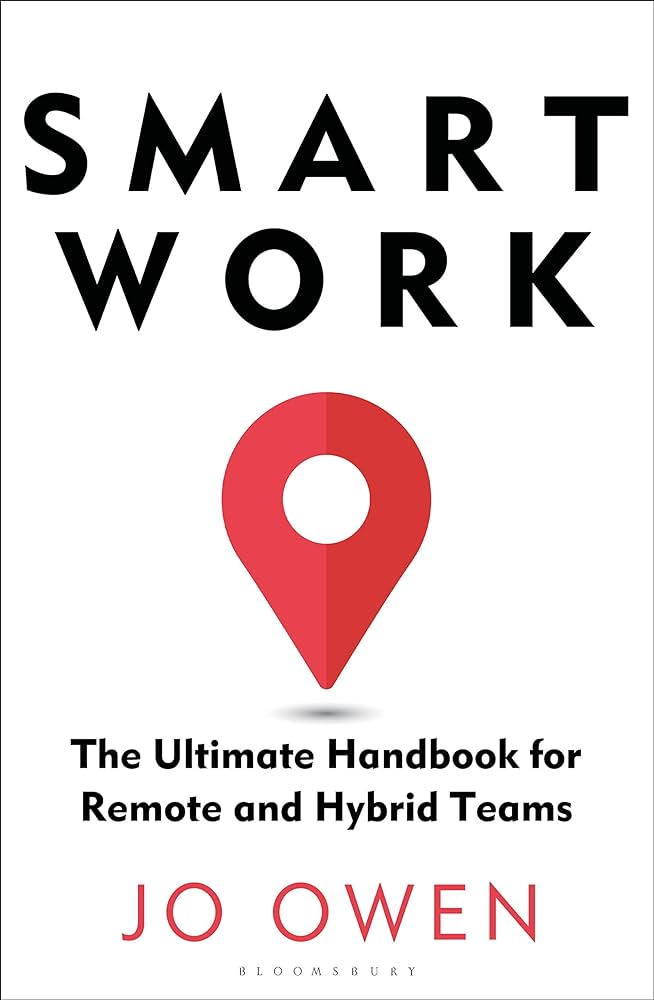
Despite the abruptness of this significant shift, it’s crucial not to overlook a key aspect. Remote work was already gaining momentum – the pandemic merely accelerated pre-existing trends. At some juncture in the not-so-distant future, companies would have had to navigate this transition regardless. If there’s a positive outcome from the pandemic, it’s the compelling reason it provided for companies to earnestly contemplate the future of work. This encapsulates the perspective of the author, Jo Owen. It’s the motivation behind his book, Smart Work – aimed at assisting companies in navigating the future’s challenges and opportunities.
What does that future entail? With the pandemic behind us, there’s a inclination to revert to the pre-Covid conditions. However, Owen believes that would be an error. We can’t simply remove Zoom and return everyone to the office. Many professionals are reluctant to do so, primarily because they value the independence that comes with working from home. Equally important, remote work offers unique benefits. Certain tasks, as it happens, can be more effectively accomplished outside the office. This is particularly evident in “cognitive” tasks, such as reading and writing reports.
However, offices also come with their distinct merits. They are excellent mechanisms for fostering trust. Teams frequently come together through serendipitous encounters at the water cooler, and solutions to problems are often most effectively addressed during informal discussions over lunch or coffee. It is also within the office that new employees grasp a company’s values, and leaders can optimally assist team members in their growth and development.
There are compelling justifications for maintaining both the traditional office and remote work setups. This amalgamation of models is termed hybrid work. According to Owen, this is the trajectory for the future of work.
Embracing this hybrid model presents a challenge, particularly for leaders. The reality is, leadership is more straightforward in the office. When everyone is physically present at the same location, it’s easier to observe who is facing challenges and who is performing effortlessly. Any issues are readily apparent. Typically, a solution can be devised immediately. In contrast, remote work doesn’t afford leaders the same level of supervision. Zoom calls don’t provide insights into what people are wearing below the waist, let alone if someone is being unproductive, facing challenges, or making an effort. There’s no chance of “accidentally” running into people in the hallway for impromptu problem discussions. Moreover, the individuals you need to persuade aren’t just a few desks away; they might be located on the other side of a city, country, or even a continent. In summary, leading remote teams poses a challenge.
However, it’s a worthwhile challenge. According to Owen, adjusting to the hybrid workplace has the potential to enhance your leadership skills.
So, let’s delve into the topic of leadership. We can begin with a renowned query that was articulated in the sixteenth century by the Italian diplomat and philosopher Niccolò Machiavelli.
He inquired whether it is preferable for a leader to be loved or feared.
He leaned towards favoring fear. Love, he argued, is capricious. A leader dependent on affection may discover that their influence lacks a foundation if the love of their followers diminishes. However, a leader who instills fear can dismiss public sentiment, as self-interest will guarantee that individuals comply with their directives regardless.
Machiavelli initially posed his question to political leaders, but it has long been a query for bosses as well. Does a company operate based on love or fear? Similar to the Italian philosopher, they often leaned towards the latter approach.
It’s understandable why this was the case. Consider a standard factory from the twentieth century. Frequently, it stood as the primary employer in a town, and akin to the residents of Italian city-states, workers had limited alternative options. This situation was compounded by the fact that a majority of them lacked specialized skills. They were readily replaceable, and thus, they adhered to instructions and refrained from expressing their opinions. This instilled fear. In such an environment, leaders didn’t aim to motivate; they held all the authority, after all. Furthermore, they didn’t perceive workers as partners in a shared endeavor; rather, they viewed them as components in a system governed by command and control principles.
As the century progressed, that scenario underwent a transformation. Workers acquired greater skills, and their bargaining power grew. The highly skilled workers, the professionals, were no longer compelled to adhere to the directives of micromanagers. If they were dissatisfied with their boss, they simply moved on and sought one they preferred. This compelled leaders to reassess Machiavelli’s question; fear was no longer an effective strategy.
Technological advancements have further strengthened this pattern. Present-day professionals wield more influence than ever, and they are unhesitant about leveraging it. Nevertheless, their desires remain constant – they seek greater autonomy. In essence, what skilled employees seek is the ability to influence the how, when, and where of their work. This explains why the prevalence of remote work was increasing even before the onset of the 2020 pandemic.
In essence, leaders cannot depend on the traditional command-and-control model; they must inspire, motivate, and view employees as partners rather than mere expendable resources. Repeated surveys consistently reveal that the primary reason professionals resign from their positions is to distance themselves from excessively controlling supervisors. In the twenty-first century, effective management involves achieving objectives through individuals you neither control nor wish to control. The solution lies neither in love nor fear; what leaders require is trust.
As we will explore, trust can manifest in various ways, but one consistent element is acting on the faith that individuals will exert their best effort, even when their actions are not visible. Paradoxically, as new technology emerges that appears custom-made for control-oriented individuals, effective leaders will need to release control. Keystroke loggers, location trackers, and constant video monitoring may be appealing to micromanagers in the short term, but they lead to detrimental long-term outcomes. Leaders depending on invasive surveillance software will discover that their lack of trust in employees is reciprocated with heightened disengagement. The most talented individuals will depart, and potential new recruits may not even consider applying.
Such a result is something no company or organization can bear.
Collaboration involves interdependence. Without this reliance on one another, it ceases to be a team and becomes a group of individuals with a common supervisor. However, trust is a prerequisite for dependency on others.
Trust is the differentiating factor. Much like adhesive, it binds everything cohesively.
Remote work underscores the crucial role of trust. In a traditional office setting, you have visual confirmation of people’s activities—you can observe their work firsthand. In remote teams, trust is essential because you have to depend on your colleagues, trusting that they are performing their tasks correctly even when you can’t physically observe them.
You can easily identify the source of trust in high-performing teams by looking at shared values, or more precisely, values alignment. In simpler terms, we tend to trust individuals more when their values align with ours. Trust is built when individuals share common goals and approaches to achieving those goals. Having aligned values provides a solid understanding of how people will act, even in situations where there is no direct supervision.
Many companies prioritize skills over values during the recruitment process. While this may seem logical, given the importance of competency, leaders often prioritize candidates with the right skills and experience for challenging positions. However, if newly hired individuals are skilled but disruptive, devious, or manipulative, their skills become irrelevant to the team. Despite being recruited for their expertise, they might ultimately be let go due to a misalignment of values.
In an ideal scenario, you would encounter individuals who possess both the required skills and align with the right values. However, if you’re unable to find candidates meeting these criteria, how do you go about assembling your team? You shift the typical sequence of priorities by prioritizing values over skills right from the start. This approach is particularly impactful for remote teams. This approach is particularly beneficial for remote teams. It’s challenging for new members to internalize or adjust to the values of an office or workplace they can’t physically witness. Additionally, training new skills proves to be more manageable than attempting to align someone with your team’s perspective on the world.
So, what do you stand for? To recruit based on values, you need to be capable of responding to that question. A useful guideline is to pinpoint a few fundamental values that become evident in challenging situations. Consider these suggestions to stimulate your thoughts about the values that define your team.
The initial concept is favorable consideration, signifying the conviction that team members are professionals committed to the team’s well-being. Embracing this perspective implies attributing issues to potential misunderstandings. This simplifies the resolution of issues without delving into political blame games. This encourages a culture where ideas can be openly and vigorously discussed, as it is evident that individuals are critiquing an idea, not the person presenting it.
Next is kindness. Remote work may create a sense of social isolation, and the absence of someone to signal the end of work can increase stress. Teams prioritizing kindness in their hiring approach will focus more on establishing strong social and professional support systems to assist team members in navigating these challenges.
Entrusting tasks to others can be challenging, and it frequently induces anxiety in leaders. The concern is that if delegation is executed too effectively, leaders might delegate themselves out of a job. While that notion isn’t entirely accurate, we’ll revisit it shortly.
Before delving further, let’s pose a straightforward question: why is delegating work so crucial? To begin addressing this question, we can examine it through the lens of a team.
Consider a scenario where the leader of a team is either unable or unwilling to delegate. In instances of significant issues arising, the leader personally handles them, viewing it as leading from the forefront. However, from the team’s perspective, this approach conveys a lack of trust – why wouldn’t the leader delegate important or challenging tasks? This marks the initiation of a detrimental cycle. A team restricted to handling only straightforward tasks is likely to face challenges in maintaining motivation. Diminished motivation doesn’t solely result in reduced productivity; it also diminishes the team’s inclination to seek learning opportunities and personal growth. Combine all these factors, and a pattern of underperformance becomes ingrained. Naturally, when a team is not meeting expectations, the leader is less likely to entrust them with additional responsibilities. Consequently, the cycle perpetuates.
That’s why delegation is crucial – it’s challenging to build the trust that sustains high-performing teams without it. This leads us to what the author refers to as a positive, self-reinforcing cycle. Assigning numerous significant responsibilities indicates a high level of trust, fostering increased motivation and continual team learning and development. The challenge is, how do you initiate this cycle?
A strategy to kickstart the virtuous cycle is to shift your perspective. Instead of pondering what tasks can be delegated, concentrate on identifying tasks that cannot be delegated. Essentially, consider a scenario where you begin with none of the work rather than all of it. Consider the tasks that are truly indispensable for you as a team leader. Certain responsibilities, such as evaluating team performance, are inherently exclusive to your role and cannot be delegated to the team itself. However, it’s likely that there are fewer essential tasks requiring your direct involvement than you initially assumed.
It is crucial to delegate a well-balanced portfolio of work. While there may be instances where you delegate mundane tasks that no one wants to do, it shouldn’t be the sole focus of your delegation efforts. It’s essential to provide team members with opportunities to tackle challenging and interesting tasks that captivate their interest and contribute to their personal growth. Effective communication plays a significant role in achieving this. Who requires it and at what stage? Are there any restricted areas? Which other individuals are part of the project? How does it align with other priorities? As a facilitator, your responsibility is to ensure everyone is aligned and informed.
Alright – entrusting tasks is crucial for your team’s motivation and morale. Where does that leave you, though? Well, to revisit our initial point, yes, you are delegating responsibilities that might make your role obsolete. However, it’s a role you shouldn’t be occupying in the first place. Professionals require leaders, not overpaid supervisors. Effective delegation allows you to focus on fulfilling the role of a true leader.
The onset of Covid-19 initiated a fundamental change in perspective. Suddenly, we had to embrace remote work. However, the conclusion of the pandemic doesn’t imply a return to the previous norms. Skilled workers had already been advocating for increased autonomy, including the privilege to work remotely, prior to the Covid era. This is unlikely to change, indicating that managers and leaders must adjust to a novel hybrid workplace – one that combines the advantages of both remote and office work.