What if you could change your life by merely altering your thoughts? What if, after adjusting your thought process, you could improve your living experience even more by being in charge of your emotions?
It may seem impossible given your past experiences or what you may have learned about happiness, but what if happiness itself wasn’t the objective?
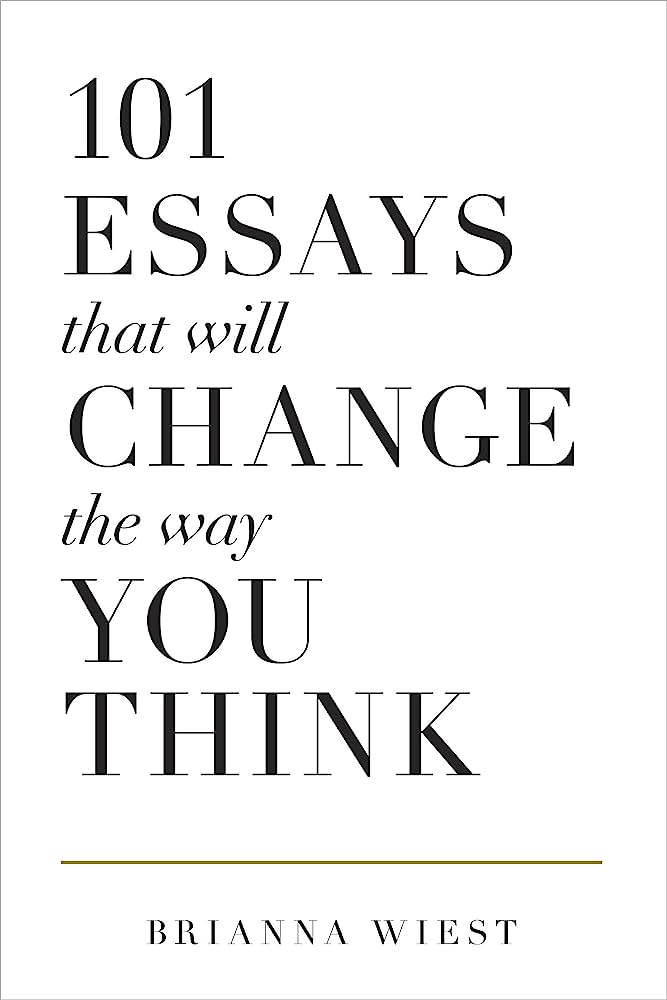
Brianna Wiest suggests dramatically revising your views in her book 101 Essays That Will Change the Way You Think, favoring a well-ordered, self-controlled existence.
What if you could change your life by merely altering your thoughts? What if, after adjusting your thought process, you could improve your living experience even more by being in charge of your emotions?
It may seem impossible given your past experiences or what you may have learned about happiness, but what if happiness itself wasn’t the objective?
Brianna Wiest suggests dramatically revising your views in her book 101 Essays That Will Change the Way You Think, favoring a well-ordered, self-controlled existence.
If the term “control” strikes you as limiting and monotonous, consider it to be the basis of delicious fruit and vibrant flowers.
Watch how that alters your viewpoint.
You’re already shifting your mentality from dull roots to delectable fruits to a healthy plant. Or, like in your instance, a person.
We can’t provide you with all 101 essays in just a few important areas. So, rather than 101, we’ve selected ten plus one of the most powerful concepts.
We are raised in a society with deeply ingrained traditions and ideals.
We acquire these ideals as we mature, unconsciously or via purposeful teaching. You may have heard at the dinner table or via conversations on social media that society has systems in place to humiliate and force dissenters.
So how are you going to survive in this monoculture?
This is the beginning of your trip. You must be aware of your ideas and feelings and accept responsibility. Your emotional anchors should be used. Cut off their access to the outside distractions of daily life. Additionally, be aware that occasionally unpleasant emotions are unfounded and may be banished by concentrating on anything else.
It is recommended and even healthier to always feel each negative and unpleasant emotion you may experience and then just let them go.
For many, having a daily routine might be the antithesis of a fulfilling life filled with adventures.
You may learn more about the most successful individuals you know by studying them, but they all had a daily schedule that helped them settle into a predictable and comfortable pattern. Thanks to this rhythm, they enter a state of flow when they appear to be working continuously and effortlessly.
Recognize the little behaviors that help you stay focused and relaxed, then incorporate them into your daily routine. You’ll discover safety, eliminate anxiety, and stop putting things off.
You truly don’t want to be happy, despite what you might think.
You’ve unconsciously established a threshold over which you experience discomfort and return to a bearable level of bliss.
Consider this: Do you recall instances in which you withheld a celebration out of concern for the discomfort of your less-accomplished friends?
Your ego alerted you to the risks of sticking out . You, turn, become a menace and a target. However, all you want is to blend in.
Try extending the duration of that wonderful feeling to increase your capacity for happiness. Embrace thankfulness, sit in meditation, and allow it to grow. Even in the worst of situations, you can remain content. It’s a decision based on becoming the best version of yourself.
Most human beings are born creative.
Whatever shape we select, when we reach a sublime degree of expression, we flourish. Despite leading arduous lifestyles, our hunter-gatherer ancestors had time to paint pictures on rocks and caves.
The human race is helpless. They are always attempting to examine and interpret the art wherever it is shown.
Find a way to express yourself creatively and practice it. Nobody else has to comprehend it or agree with it. It simply need to be an activity you find enjoyable. Don’t judge it; just let it happen. Don’t give in to the urge to copy.
Do it consciously, regularly, and for its own sake until it becomes a habit and an intuition.
How can you automate learned talents until they are as natural as breathing?
So here’s your three-step brilliance formula!
Learn everything you can about the talent you’re interested in and how it’s used. Apply what you’ve learned as soon as you can, and keep a record of your errors so you may remember them.
Next, while you use the skill from memory, attempt to remember each step involved. Why? You’re more likely to recall a string of occurrences than a singular experience. Over time, you’ll discover that it gets simpler.
Through repetition, the third phase will put you on autopilot. You’ll have a sense of ease and enter a flow state as you unconsciously carry out chores.
Recall the lesson you learned about utilizing your ideas to regulate your emotions. You may do similar actions to raise your self-esteem.
Consider it as your capacity for self-management. Work on improving your talents deliberately and purposefully, and you’ll see a gradual increase in your confidence. Keep your high moral and ethical standards driven by your own beliefs and sense of worth rather than rules set by others. . Fear fuels defensiveness.
There won’t be highs for you every day, but you will feel at ease knowing that you have control over your life.
While it is recommended that we follow our hearts, what if we let our minds take the helm instead?
The key is to recognise where one begins and the other finishes rather than choosing one over the other. A desire may be sparked by passion, but as you advance, it will wane.
The head begins to make sense at that point. Deliberate purpose will help you stay focused, identify and acquire the abilities necessary to complete everyday activities and give you the fortitude to put off immediate fulfillment.
Be thankful for your little accomplishments. The steadiness and tenacity of your goal outweigh the hysterical urge to fill whatever gap you may be experiencing. Shared values can even make interpersonal connections much more satisfying.
Denis Diderot, a philosopher of the French Enlightenment, wrote in a well-known article on how receiving a new red dressing robe caused him to be sad and incur debt.
Overnight, his older items lost their appeal. To match the novelty of his new dressing robe, he hurried to replace them. You understand what I’m saying if you’ve ever purchased a dress and immediately considered the shoes that accompany it.
Advertisements, friends, and celebrities persuade us to make additional purchases. To find fulfillment in a materialistic existence is such a difficult endeavour.
Instead, maintain your attention on what is truly important.
We’ve discussed a few concepts thus far, hoping they would alter your perspective.
Three more concepts remain, so here’s an encore.
Learn to rest first. Sleep well, think things over, and carve out some downtime. You become exhausted from maintaining constant laser focus. Your mind analyses events, solves problems, and discovers answers more frequently while you are not paying attention.
Prejudice should be avoided. When it comes to younger individuals who are still figuring things out in the world, this is extremely crucial. Being judged usually enhance e our natural reaction to repress our emotions. But later in life, this can frequently result in worry and anxiety.
Finally, develop the ability to assess and enhance your life by harnessing the power of negative thinking. While you have no control over what the universe hands you, you have a choice in how you play the cards given to you. Use these hypothetical situations to think out your response to negative thoughts rather than fighting them. Control your fear and use it as fuel for motivation.
Changing your viewpoint will also alter how you tackle every challenge you face in life.
Many of the beliefs you hold to be true have roots in the prevailing culture in your area. You must tune out the noise and develop independent thought to discover your way. Use your thoughts consciously to prioritise your priorities. As you build perspective — that window through which you see everything — this will alter how you feel about many things.
From this point, it is simpler to establish an effective routine that will serve as the cornerstone of your goal and keep you a healthy distance from the vagaries of passion. When your plans change from the adrenaline of the ultimate accomplishment to the daily activities you’ll grow to appreciate, you’ll experience genuine fulfilment. As you begin to operate on autopilot, these routine duties will turn you into a creative powerhouse. Your self-esteem will rise if you believe in your capacity to function and handle your affairs.
You may start by being kind to yourself in this way. It also has to do with how you behave in the world.