“To be a superhero, you don’t need a Batmobile or a golden lasso. You just need to be yourself, that’s all!”
That’s accurate. Anyone have the potential to be an everyday hero, and all we need are two things you probably already have: a critical mind and a caring heart. Unleashing your full potential is the definition of becoming a hero to yourself.
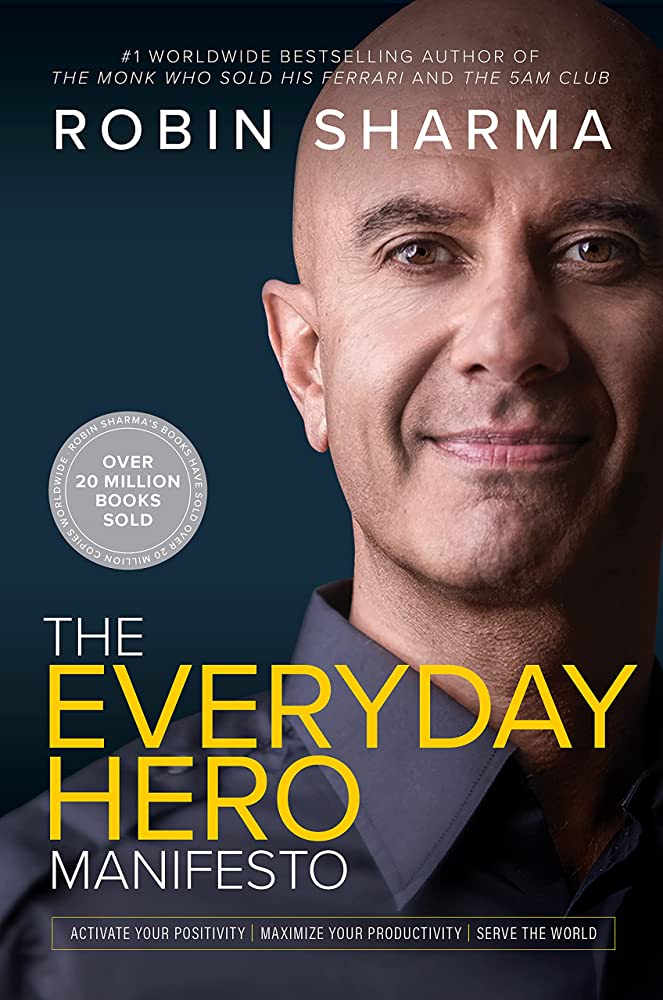
We’ll give you some surprisingly achievable advice and walk you through some tried-and-true methods you can apply in your own life to bring out your inner hero in Robin Sharma’s book The Everyday Hero Manifesto. Instead of receiving instructions for some hidden weapons, you will learn how making little changes in your life may have a big impact.
Make use of a focused and creative place by carefully organizing your surroundings, both inside and out. Free the idealized, prosperous version of yourself that is waiting inside by doing this.
You’ll discover the following fundamental concepts.
Hero is a term that is often used.
We hear stories of brave people who land aircraft in perilous situations or heroes who storm burning buildings to save others. Heroes like Mahatma Gandhi and Rosa Parks fight injustice, while others overcome adversity to achieve astounding success in sports, music, and the arts.
Yet a hero need not necessarily be outspoken and visible. Every one of us has a heroic power, according to author and motivational speaker Robin Sharma. Everyday heroes may be anybody who constantly y aspires to live their life with beauty, dignity, self-respect, joy, courage, and inventiveness. It is not necessary to win the genetic lottery to become brilliant. Everyone who is prepared to put in the effort to achieve it may achieve their objective.
Consider the author as an example. In his 30s, he made the decision that he wanted to live a better, richer, and more meaningful life, so he went out to learn how to do it. As his family slept, he got up early every day to study how to increase his output, self-assurance, and happiness. Three years later, he felt changed. At that time, he had worked with specialists, attended conferences, and hired coaches. The Monk Who Sold His Ferrari is the title of the book he authored to document his travels.
There was just one issue. He was completely ignorant about publishing. His father, a family doctor, took him to the copy shop to print up his first few copies while his mother, a teacher, edited the book. Reading the copies was challenging. Editors put him off. Few people attended his first reading. He continued despite all outward discouragement, his confidence triumphing.
Then, one day, while he was signing the six copies of his book that he had given the owner of the bookshop on consignment, a guy approached him and asked what the name of his book was. Robin enthusiastically filled him in, grabbing the chance to share his passion for the book and its message with the stranger.
Fortunately, that individual happened to be the leader of the influential publishing company Harper Collins. Anybody who is aware with The Monk Who Sold His Ferrari’s blockbuster fame will know that the rest is history.
What is the story’s lesson? There are a few, I guess.
One is that we all possess the potential for great work, and it is our responsibility to uncover, refine, and unleash this potential. The second is that your act of bravery required unwavering self-confidence and dedication to greatness. Finally, even though it could take some time for everything to come together, if you manage your travel properly, you will eventually get where you’re going.
So what is the first lesson in becoming your own daily hero? Stop waiting. The proverb “Action delayed is grandeur betrayed” is one that Robin often uses.
All of this may seem really motivating, but how exactly can you become a hero, you may wonder? The demands of family obligations or the need to make payments on debt might make it simple to feel stuck. By yelling back that now isn’t the time, you may easily silence the voice in your brain that nudges you to think bigger and do more.
Robin doesn’t only provide motivation; he also offers helpful advice and step-by-step instructions to help you transform your mundane life into one that is filled with hope and pleasure. Let’s begin with his five recommendations for making the transition from victim to hero.
The first shift is from “can’t” to “can,” and the key is to express it clearly. Words have great power. Your brain is bathed in the emotions and vibe that your words to yourself elicit. Every morning, start your day off well by encouraging yourself, let’s say in front of a mirror. It may sound stupid but it can actually help. In the meanwhile, you might borrow Robin’s advice and say, “I am very glad for the day ahead with all its beauty, delights, and excitements.”
What if you begin this way, then later on your thoughts go from anger, to anxiety, or any other unfavourable emotion? If negativity starts to creep in, remove any negative thought it and say, “Let’s not go there.” Maybe this seems simple, but if you do it often enough, you’ll soon learn to listen to yourself!
Shift two is from justifications to outcomes. There are a hundred reasons why you can’t do something, but there is only one real justification for your ability to do it: you should! Don’t allow doubters get the better of you. Editors rejected J. K. Rowling’s manuscript for a mystery series she authored under the pseudonym Robert Galbraith, but they advised her to join a writing club to hone her craft. Keep in mind that a person’s rejection is just that -their view.
It’s possible that painful memories from the past, such as rejection, are still looming before your eyes. Maybe a teacher in high school warned you that you would never amount to anything. Possibly a parent expressed concern aloud that your goals were too ambitious. Each of us carries with us pieces of our history that work to limit us. Instead than letting the past bind them, successful individuals use shift three, using it as fuel for their future successes.
Working hard is essential, but the distinction between being busy and being productive should be made. Nowadays, everyone is occupied. But carefully consider what you are now doing. Is it the perseverance required to develop brilliance and hone your profession or skill? Or is it occupied with chatting, shopping, or using social media? Making the transition from being busy to being productive is the fourth shift to being an everyday hero.
Don’t be a taker is the fifth and final shift. Be generous. Robin’s mentors are always emphasising the value of charity and how to make a difference in the lives of others. The message is the same, whether it comes from Apple co-founder Steve Wozniak or Robin’s father, a family doctor from modest origins who quietly practiced for 54 years. Be modest.
It was hard for J. D. Salinger to ignore his raving followers when he was inundated with excessive attention after The Catcher in the Rye’s triumph. Salinger thus had an underground tunnel constructed so he could quietly stroll from his house to his workplace. Salinger recognised the need of safeguarding his own ecology. Your mind and heart are affected by the energy you are surrounded by, which also has an impact on the course of your life and work.
Who do you regularly speak with? Which social media influencers do you follow? What do you watch, listen to, and read? Who eats what? How do you navigate? Everything you consume has an impact. This is what Robin calls the IPOP principle: You can only produce positivity if you input it. To safeguard your aspirations and inspirations, it’s critical to carefully design and nurture your surroundings.
This way of thinking also applies to preserving Robin’s “Trinity of Radiant Vitality.” Exercise, diet, and rest form the trinity. Despite the validity of the word, they are doable objectives. Start the first half of this trinity in the morning with a strenuous, sweating exercise to enhance inspiration and release dopamine. Moreover, norepinephrine, which aids in achieving peak focus, and brain-derived neurotrophic factor (BDNF), which enables the generation and repair of new brain cells, will be released. Not a horrible combination of substances that your body can readily produce. Afterwards, in the early evening, engage in further physical activity, even if it just entails a stroll. If it’s outdoors in nature, bonus points. Including stretching and weight training.
Nutrition is the second aspect of the trinity. We probably all agree, at this point, that local, fresh food is always better. Regrettably, it is insufficient. Today’s food is less nutrient-dense than food produced in the earth even ten years ago due to the degradation of our land. It’s crucial to supplement for this reason. Robin advises having your DNA examined in order to most efficiently provide your body a personalised diet. It also helps to fast. You’ll have more energy if you reduce your calorie intake even a little bit each week to assist your body get rid of old, damaged cells.
The third component of the trinity, recuperation, may be the most enjoyable.
Nowadays, cognitive workers make up the bulk of the workforce. They get compensated for their ideas and innovations rather than for working eight hours a day on a manufacturing floor. It is preferable to concentrate intensely and deeply for a little period of time and then utilise the remainder of the day to recover and refocus in order to be the most productive cognitive worker. Depending on what helps you enter your optimal state of productivity, whether it’s a lengthy afternoon sleep, an evening spent curled up on the couch with a good book, a fine dinner, or a trip to a new location, that might look different for everyone. Although while taking a weekend off to stroll on the beach can sound indulgent, scheduling recuperation is crucial if you want to maintain your productivity.
Let’s explore ways to safeguard your productivity in more detail. This is both tougher and simpler than you may expect, and putting up the effort to accomplish it can pay off in tremendous ways.
Each and every one of us has a cognitive bandwidth, which is the daily capacity for attention of the human brain. This is a limited supply, so treat it with care. Focus on that one task at a time while you are working on it without moving to other things since every time you transition from one activity to another, you lose a little bit of attention. The term attention residue refers to this phenomenon. Hence, the next time a message flashes over your mobile phone screen while you’re working, consider if you want to pay that creative cost before picking up the phone.
One thing to avoid doing is that. Yet there are many other things you can do to keep your productivity at its highest level. Some are as easy as getting up at five in the morning and concentrating on things that develop your talents and are in line with your ideals. The first 90 minutes of your workday should be devoted to your most productive pursuits. Keep a thankfulness notebook, a habit that has been shown to increase happiness and productivity, for at least 10 minutes each day. A difference may be made by just acknowledging three minor victories each day.
Having the appropriate people around you is a further approach to increase productivity. The additional benefit of employing real experts is that you are compelled to heed their suggestions, a process Robin refers to as “forced optimization.” It’s simple enough to click snooze 10 times and decide you’ll try again at the weekend if your alarm is set at 6 a.m. to run a mile. Although you should have hired a personal trainer or fitness coach to arrive at your home at 5 a.m. to avoid that mile being missed as one of the many dreams you would encounter in that one spare hour of sleep.
Massage therapists, psychotherapists, functional physicians, and spiritual counsellors are additional experts who may assist you improve. The secret is to pay for their services in advance. If you hire a top-notch executive assistant or personal aide, you may free up a tonne of bandwidth by delegating activities like travel planning and bill payment to them.
You may develop your TBTF: Tight Bubble of Total Focus by using any or all of the tools and approaches mentioned above. Preserve your ability to concentrate, physical stamina, willpower, time, and talents. This may include going to the library to work or perhaps reserving a hotel room for a day of undisturbed work. If you’re looking for ideas on how to design a space where you can completely concentrate on yourself, consider Ian Fleming’s lovely seaside hideaway in Jamaica, where he authored the enduring James Bond books. And we already know how fruitful that endeavor was!
Priming your mind to perform at its best is a topic we’ve covered extensively. Yet when the heart is supporting the intellect, the mind functions at its best. It’s crucial to commit fully, which entails doing it from the bottom of your heart and soul.
However, the heart is a complicated organ. Virtually everyone has unresolved emotions from the past that continue to influence their behavior now. The best course of action is to recognise this “field of pain” rather than ignoring them or dismissing them as a waste of time when pursuing a goal.
We think a lot but don’t feel nearly enough. We may harm others more easily because of this. The term AFRA, which stands for Awareness, Feel, Release, and Ascend, is what Robin uses to break this loop. The next time you respond strongly or maybe disproportionately to something—say, because your spouse gave you a present that was obviously thoughtless—become conscious of how you’re feeling rather than how you’re thinking. Do you get stomach pain? Does it hurt to swallow? Do you breathe heavily? Don’t analyse it logically; just name the sensation in your body. Now, really experience it. Give yourself up to your emotions. Take a seat in it. Next, make a decision to fully release the emotion. Eventually, climb up and over it.
It’s crucial to fully and thoroughly complete each of the aforementioned tasks. Avoid false optimism since it may be just as harmful as suffering itself because it masks the reality and anguish of what is truly occurring. It may be difficult to think these things through honestly and can rob you of genuine emotion if you convince yourself that you’re okay when you’re not.
Will the procedure be simple? Very likely not, but nothing worthwhile is simple. It might seem like an uphill battle to put in the hard work of working through emotional pain to become a more feeling person, and then to put in the hard work of creating habits and an environment that drive you to accomplish your best. When you encounter a brick wall, keep in mind that it will pass. Sometimes a hardship that appears insurmountable may end up being a godsend; for example, you could miss a flight but meet the love of your life while waiting for the next one at the airport bar. Also, difficult circumstances may test your drive for the goal you’re pushing yourself towards and help you improve.
Keep in mind that possibilities may be found amid turmoil. When faced with difficult decisions, difficult challenges, and internal conflict, that’s when you may summon all of your inner strength and battle to prevail. You’ll do this by acting like the daily hero you’ve always been.
The most crucial thing to take away from this little book is:
We all have the power to transform into better, more focused, more successful, and even happier, more contented versions of ourselves. We may do this by being aware of what we eat, what we think, what we expose ourselves to, and how we behave. We may regain control and steer our own lives to success by preserving our productivity and customizing our surroundings.
Here’s one more great advice:
Make a list of motivational sayings.
Robin Sharma enjoys sayings and proverbs that provoke thought or help him understand a deeper, universal truth. It’s crucial to surround oneself with positive people because words count. Write down any quotes or sayings that inspire you or speak to you on a little notecard and keep them all close at hand for daily reference.